Показват се публикациите с етикет Jesus Christ. Показване на всички публикации

понеделник, октомври 10, 2016

Paradise Lost (Genesis 3)

/sermon by Mike Enns (Germany)/


- (Greetings) -> to our guests the Americans
- I hope you will get used to this country soon           - I know America is very different
-Did you know for example in Wisconcin it is illegal to be served magarine in restaurants.
    ->it may seem weird but humans made many different kinds of weird laws:
                      - In Sweden you are not allowed to paint your house without a painting license
                      - Only electricians are allowed to change light bulbs in Australia
                      - In Bulgaria apparently you need to have a fire extinguisher in every car.
- It’s very interesting what humans come up with. 
- the  American declaration of independency has 1,300 words
     -> the European regulations on the sale of a cabbage - 26,911 words
      -> The ten commandments by the way had only 179 words
-You could almost say the fewer the words the more important.
- Do you know these people who say that in the past everything was better?
 -> I don’t think so……..well but sometimes they are right.
    -> There was one place with only one law.     – it had 23 words by the way. If I counted right
                                                                                 Hebrew is not my best subject.

-        That was the garden of Eden and the law was     -----(slide of genesis 2, 16-17)
(16 And the Lord God commanded the man, saying, “Of every tree of the garden you may freely eat; 17 but of the tree of the knowledge of good and evil you shall not eat, for in the day that you eat of it you shall surely die.”)

-        As you remember we are doing a sermon serious. The gospel of Genesis and now we reached the garden of Eden In Genesis Chapter 3
-        We want to read together the Verses 1-6:………..
Now the serpent was more cunning than any beast of the field which the Lord God had made. And he said to the woman, “Has God indeed said, ‘You shall not eat of every tree of the garden’?”
2 And the woman said to the serpent, “We may eat the fruit of the trees of the garden; 3 but of the fruit of the tree which is in the midst of the garden, God has said, ‘You shall not eat it, nor shall you touch it, lest you die.’”
4 Then the serpent said to the woman, “You will not surely die. 5 For God knows that in the day you eat of it your eyes will be opened, and you will be like God, knowing good and evil.”
6 So when the woman saw that the tree was good for food, that it was pleasant to the eyes, and a tree desirable to make one wise, she took of its fruit and ate. She also gave to her husband with her, and he ate.
-        So all we had were 23 Words of God and we still managed to break it.
            ->a Break with his commands and a break with him.
            ->We humans committed the first sin.

-I don’t know what picture you have of the Gospel? But I know for many the old testament is a different closed of part of history

But isn’t it so much more than that? Isn’t the reason why Jesus came to us, why he had to die for us. Why we needed his sinless sacrifice right here?      -The sin which started everything.

It’s the beginning of the working of Jesus Christ and God’s mercy…
-Jesus said in Matthew 5:17, "Think not that I am come to destroy the law, or the prophets: I am not come to destroy, but to fulfil."
 -> fulfil what was set in motion at this very point.

Because that is what was needed to free us from the consequences of this sin.
 Because we Humans pulled away so far from God at that day , that he had to reach out to us by sending Jesus to bring us back.
-The price of that first sin is as heavy as the ones today.  It cost the Life of Jesus Christ on the Cross
-in our stead he was tortured to death.        –Executed as a criminal    -humiliated and beaten.

Why was the necessary? Isn’t that question worth riddling?....
I think the first 3 chapters of Genesis are very important.
-        Trif talked already about why we exist and what we gained in God and today is time to see what we lose in sin.
 Read verse 7-24
( Then the eyes of both of them were opened, and they knew that they were naked; and they sewed fig leaves together and made themselves coverings…………..)


-        I don’t  know how you feel about this but That doesn’t sound so good reading it
-        I don’t think that was worth the effort of eating the fruit.
-        Like in many sins regret comes later.
-        There is all that hiding from God and then shifting the blame,…Getting cursed by God.

….Who’s fault was it?
-        Was it Eves fault was deceived by Satan and who took the first bite?
-        Adam because he heeded the voice of his wife and did not stop her?
-        Or of the cunning serpent? Satan?     -What do you think?


The answer is simple.  Everybody’s.
             Romans 3 verse,23
for all have sinned and fall short of the glory of God
It does not matter if you are rich or poor, strong or weak, old or young, Christian or non-Christian
-        Even the serpent got cursed for sinning against God.
-        So now Just as we crawl through sin it has to crawl over the earth.

But how good is it that the gospel doesn’t end there.
-        Verse24and all are justified freely by his grace through the redemption that came by Christ Jesus.
What was started thousands of years ago.
-even longer ago than we are away from Jesus was brought to a close by him
-        Or better to say an open end for us to join.
-        Because in him we can find redemption
-        Redemption for this first sin which still haunts humanity as well as the many we add ourselves.
-        Jesus Christ took them already to the grave with him 2000 years ago
-        So it is only on us to accept it.

I know that there might be a great many things holding us back from accepting
-So I want to remind you that today we only looked at the starting line and the finishing line of the gospel.
-There is a lot more to be found on the way.
-A german once said “Der Weg ist das Ziel”       Пътуването е целта.
There is a lot of interesting things to be discovered if you take the time
-So I want to encourage everyone to read the bible.
-The value is unimaginable


Earlier I asked kind of a stupid question but I think we need to look at it and draw out the results of our action taken to learn from them.

I asked: was it worth it?
-That sounds like a bad question. And it is in many ways but in others not I think.
- There was a man who loved old books. He met an acquaintance who had just thrown away a Bible that had been stored in the attic of his ancestral home for generations.
-"I couldn't read it," the friend explained. "Somebody named Guten-something had printed it."
-"Gutenberg!" the book lover exclaimed in horror. "That Bible was one of the first books ever printed. Why, a copy just sold for over two million dollars!"
- His friend was unimpressed. "Mine wouldn't have brought a dollar. Some fellow named Martin Luther had scribbled all over it in German." 
Sometimes we have to try hard to find the value of things.


Well Let’s see what we gained from this choice Adam and Eve took.

I think this first sin brought us that day what it still does today.
Or said the other way round we still lose the same things we lost thousands of years ago in sin.
-        It separates us from God.
-         It brings us shame     -it hides us away from God. Not because he can’t find us but because we don’t want to be found.
-        Nietsche said God is dead and we have killed him    
-        He calls for Adam not because he doesn’t know where he is but because he wants him to come to him on his own.
-        Once more and most of all the sin brings us death just like God said in chapter 2 verse 17
-        As sad as it is. We have all tasted this fruit. We are all sinners. And we will all find death.
è Or so it was supposed to happen

-Ephesians 2:8 For by grace you have been saved through faith. And this is not your own doing; it is the gift of God,

The humans, adam and eve had a choice and they choose to eat the fruit of death and that brought sin over us till this day.

The Value of it is not in there action but what we learn from it and if we don’t learn anything from it would be a tragedy!

-        I always felt it was kind of unfair. Why do we have to suffer for what they did?....

-        But I realized. They were given a choice by God.

-        That is why the fruit has been placed there in the beginning anyway.

-        And just as they do we have the choice as well.

-        God has placed a fruit of us as well. A fruit of life and not of death.  And he told us to eat it.

Romans 6,22-23 we read

But now having been set free from sin, and having become slaves of God, you have your fruit to holiness, and the end, everlasting life. 23 For the wages of sin is death, but the gift of God is eternal life in Christ Jesus our Lord.

-        Just as adam and eve made choice to eat the fruit.

-         Everbody today does as well.          they  don’t just have this choice but they make it.

-         Provided by jesus blood and God’s grace.


-        To eat it…. it is on us.                                   -Amen


---
New Life Church Varna
October 9, 2016

понеделник, януари 12, 2015

Пътеводител на християнския стопаджия

/проповед/

Обичате ли да получавате поздравителни картички? Едно семейство получило поздравителна картичка за раждането на тяхното бебе. На нея пишело: „Как може двама толкова красиви хора да имат толкова грозно бебе?”

Днес все по-малко хора изпращат картички по пощата. Днес хората се обаждат по телефона и пишат пожелания във фейсбук за рождените дни и празниците на своите близки и приятели. Обикновено пожеланието е „много живот, здраве и щастие!” Повечето пожелания не се отличават с oсобена оригиналност.

Петър също започва писмото си с поздрав. Но за него поздравите са нещо повече от формалност. Първите християни са се поздравявали с „Хаирейн” – Желая ти радост! Петър обаче приветства с пожелание за благодат. Той пише: „Благодат и мир да ви се умножи!” Благодатта е Божията любов в действие. С други думи, той казва: „Божията любов да подейства в живота ти!” Това е много повече от пожелание.

„Благодат и мир да ви се умножи!”

В апостолското приветствие благодатта е свързана с мира. В СЗ свещениците са изричали Божието благословение за мир, с което се благославяме и ние в края на служба: „Господ да издигне лицето Си над тебе и да ти даде мир!” (Числ. 6:26). Израел е загубил това благословение поради греховете си, но неговите пророци виждат деня, когато Бог ще изпрати Княза на мира и ще освободи Своя народ не само от потисниците, но и от греховете му (Мих. 7:14-20).

Симон Петър познава Княза на мира. Той идва не за да донесе политически мир, а мир даден в сянката на кръста. Затова неговият поздрав „Благодат и мир да ви с умножи” е обобщение на цялото послание. Петър пише на онези, които чувстват презрението и злобата на невярващия свят. Апостолът пише от Рим около 63 г.сл.Хр., когато на власт е Нерон, само година преди големия пожар в Рим.

Някога Петър беше извадил нож, за да не допусне да арестуват Исус. Сега Петър благославя с мир, който идва не чрез меч, а чрез кръста. Скоро ще настъпят бурни времена на гонения. Целта на Петър е да задълбочи познанието на цялата Църква в Мала Азия, за да могат вярващите да посрещнат изпитанията със силна надежда в Христос.

Петър започва, като казва, че е апостол на Исус Христос (1:1). Той е упълномощен от него да проповядва в Негово име. Затова когато четем неговото послание, ние ставаме приемници на апостолските истини. Така стъпваме на темелите, положени от апостолите. Живото апостолско слово, а не старовременните одежди, архаичния език и древните ритуали определя коя е истинската Църква Христова. Затова когато четем псланието ние четем не толкова посланието на Петър до християните в Мала Азия; ние четем посланието на Духа на Христос до Църквата на всички времена!

По-нататък, Петър нарича неюдеите в тези църкви „избрани по предузнанието на Бога Отца” (1:2). В Деяния четем как Бог е променил ума на този обрязан юдеин и от човек, който не понася езичниците той ги привества като избран от Бога и свят народ!

Петър е видял как богобоязливият езичник Корнилий и семейството му са получили същия Свят Дух, който слиза над вярващите юдеи на Петдесятница. Бог ги е предузнал и тяхното присъединяване към Божия народ не е приумица, а цел на Бога отпреди създанието на света. И сега те са обект на Неговата безвъзмездна благодат и предопределена любов. Бог е техният Отец. Затова те трябва да оставят своя грях и да станат святи, защото Бог е свят. (1:16).

„...избрани по предузнанието на Бога Отца, чрез освещението на Духа, за да сте послушни и да бъдете поръсени с кръвта на Исус Христос.” (1:2)

Петър говори за Святия Дух и за Исус Христос, като описва как Бог е осъществил своя велик замисъл. Бог избира Своя народ „чрез освещението на Духа, за да сте послушни и да бъдете поръсени с кръвта на Исус Христос” (1:2). Триединният Бог – Отец, Син и Свят Дух, осъществява нашето спасение.

Святият Дух ни освещава първоначално, пренасочвайки ни от живот в греха към живот в святост. Нашето послушание води към спасителна вяра. Христовата кръв пък, поръсена върху нас означава, че Бог ни е приел, защото наказанието за греха е понесено. Някога Петър увещава Исус да не отива на смърт на кръста: „Бог да ти се смили, Господи; това никак няма да стане с Тебе” (Мат. 16:22б). Но сега той разбира необходимостта от смъртта на Христос и смисъла на Неговото възкресение. Исус „сам понесе в тялото Си нашите грехове на дървото, така че като сме умрели за греховете, да живеем за правдата” (2:24).

„Пръснати” и „пришълци”

И най-накрая, тези неюдеи, които се наричат Божи народ, избран от Отца, осветен в Духа и поръсен с кръвта на Исус, са още ‘пръснати’ и ‘пришълци’, т.е., чужденци, временно пребиваващи, странници, отправили се към своята родна земя. Какво иска да каже с тези две думи Петър? Какви са тези странници, пришълци?

В „Пътешественикът” на Джон Бънян виждаме класически пример за земното ни странстване в следване на Христос. Християн е толкова силно привлечен от Небесния град, че не обръща много внимание на света, през който преминава. Не се спира, за да построи молитвен дом в Града на суетата, не намира и средства да пресуши Тинята на отчаянието.

Авраам беше пришълец в Обещаната му от Бога земя. Той дори нямаше собственост в нея с изключение на пещерата Макпелах, където погреба Сара. Но гледаше към Божиите обещания и към Небесния град.

В духовен смисъл ние също сме странници и пришълци в този свят. Но как да живеем тогава? Дали да бягаме от света или да се борим срещу него? Да се приспособяваме ли като някои духовни хамелеони или да се опитваме да го променим? Какво означава да сме пришълци в една страна, където властва злото в най-различните му измерения, в която княз е Сатана? Как можем да сме патриоти в една страна, която не можем да припознаем като своя родина?

Думата, използвана на гр. език за „пръснати” е „диаспорас”. От там идва и думата диаспора - хора от даден народ, разпръснати в чужди страни. Ние, българите, знаем какво означава разпръснат народ. След освобождението от турско робство и войните, много българи остават в други страни. Днес много българи сами решават да емигрират. В миналото сме били уседнал народ (макар и да ни вменяваха номадството), но ето че все повече от нас днес стават емигранти. Превръщаме се в народ от номади.

Тези съвременни номади са наречени от френския християнски философ Жан Брун „скитниците на Запада”. Човек, казва той, е странник, който се стреми да избяга от самия себе си. Той оприличава съвременния човек на полубога, получовек Тантал от гръцката митология, който е осъден да страда от вечна жажда под клони, отрупани със зрели плодове, които така и не може да достигне.

По същия начин човекът от западната цивилизация, към която и ние се числим, напразно иска да преодолее ограниченията на пространството и времето, като изобретява все нови и нови технологии, мечтаейки да достигне колкото е възможно по-далече и по-високо. Лелее да построи своята Вавилонска кула. Човекът иска да има власт над природата, да бъде сам бог на своя живот.

Човекът на изтока също търси пътя към небето, но при него той е насочен не навън, а навътре. За разлика от западняка, Буда не протяга ръце към непознатото или новите технологии, а ги държи скръстени (Брун).

Буда живял като принц в двореца. Там не му липсвало нищо. Но като станал на 29 г. решил да излезе за пръв път навън и да се запознае с в живота на обикновените хора. Там видял стар човек, болен човек и разлагащ се труп. Така се сблъскал с дукха, страданието.

Започнал да се пита как може да избегне дукха. Изход от страданието намерил в осмократния път (правилно разбиране, правилна мисъл, правилна реч, правилно поведение, правилни средства, правилно отношение, правилно мислене, правилна концентрация (медитация). Колко различно от учението на Христос, който казва, че не можем да се спасим със собствени усилия!

За човека на изтока изходът от съвременната ‘дукха’ (стрес, мъка, страдание) е в потискането на желанията. Както се изразява Жан Брун, „източният мистик не грабва инструменти, за да построи кула до небето, а използва ръцете си в стилизирани жестове на медитацията и танца. Той нарича живота на земята илюзия, но така става жертва на истинска илюзия и не може да се освободи от непрестанното чувство за несретност и мъка.”

Както западният практик, така и източният мистик се стремят към собствена слава. Както казва св. Августин, „земният град се слави със себе си, небесният Град се слави с Господа”.

В историята на човечеството виждаме този стремеж към бягство от реалността и дирене на духовно съвършенство и вътрешен мир, в непрестанните човешки търсения. Велики империи като Асирия, Вавилон, Персия и Рим, Армения, България, а днес и Русия, са търсили постигане на трансцедентното в политическото господство.

Велики пълководци като Александър Велики са се стремили да завоюват нови и непознати земи. Виждаме го у поклонниците и кръстоносните походи в средновековието. Колумб също е вярвал, че изпълнява мисия на разпространение на християнството, когато открива новия свят.

След това виждаме първите заселници в Америка, които бягат от религиозно преследване в Англия с намерението да установят един нов свят, където да бъде „Божията воля, както на небето”. Виждаме този трансцедентен копнеж дори в богохулника Ницше, който копнее за свръхчовека. Този копнеж по-късно ще се изроди в уродливата теория и практика на националсоциализма и комунизма, чийто призрак още броди по разбитите плочки на чалгизирания ни град.

Днес това преследване на трансцедентното е видно и в стремежа на човечеството да покори космоса и установи извънземни форми на живот. Мантрата, повтаряна от мнозина в нашия технологичен век е „Трябва да има някой там някъде!” Много хора мечтаят генното инженерство да създаде нов вид хора, които да владеят „Силата”. Новата митология и опиум на народите, родени с Междузвездни войни, е научната фантастика.

Всички тези усилия за намиране на трансцедентност в невярващия свят обаче са напразни и безплодни. Затова в увода към своето послание, Петър ни напомня, че ние сме пришълци в света. Ние не принадлежим на този свят. Той не е нашият дом. Ние се новородихме, за да живеем другаде. И ако не помним това, можем да се депресираме. Защото Исус ни каза: „В света имате скръб.” (Йоан 16:33).

Тази скръб кара хората да търсят пътя към рая, но не го намират, защото не търсят Пътя. Хората са депресирани и в отчаянието си чукат на всяка врата, изпречила им се на пътя, но не посягат към Вратата Исус. Шест милиарда духовни стопаджии са объркали пътя и се нуждаят от верен компас! Нуждаят се от пътеводител.

Кой друг ако не Църквата Христова ще ги насочи към Христос? Затова Петър е загрижен за свидетелството на християнската Църква пред езичниците, сред които живеят вярващите (2:11-12, 3:15-16). За Петър християните са пришълци и чужденци, но и посланици. Те отхвърлят безкритичното приспособяване към света, но приемат отговорността да живеят като уважават закона, почитат управниците и своите сънародници.

Въпросът, който Петър ни задава днес е: какво прави църква „Нов живот” Варна, за да стане пътеводител за тези изгубени странници? Какво правиш ти, за да насочиш духовните стопаджии от твоето семейство, твоя блок, твоята работа? Божий посланик ли си за тях? Молиш ли се за тях? Свидетелстваш ли им за вратата Исус? Насочваш ли ги към небесния Ерусалим? Каниш ли ги на църква, за да се запознаят с други граждани на Божия град?

Хората на запада живеят с илюзията, че могат да намерят щастие в земния Вавилон. Хората на изтока живеят с илюзията, че могат да намерят покой чрез бягство от удоволствията вътре в себе си чрез медитиране. Ние сме избрани по предузнанието на Отца, осветени от Духа и измити от кръвта на Исус Христос. Затова единственият начин да стигнем до небесния Ерусалим е не чрез собствени усилия, а чрез поклонение пред Бога. Защото сме странници в този свят. Нашият дом е на небето.


Молитва. 

БПЦ "Нов живот" - Варна
11.01.2015 г.

петък, април 13, 2012

Христос воскресе! Christ Is Risen!


„Ако Великден ни говори нещо днес, то е следното: можете да заровите Истината в гроб, но тя няма да остане там. Можете да я приковете на кръст, да я увиете в плащеница и да я затворите в гробница, но тя ще възкръсне!” Кларънс Хол

"If Easter says anything to us today, it says this: You can put truth in a grave, but it won't stay there. You can nail it to a cross, wrap it in winding sheets and shut it up in a tomb, but it will rise!"
Clarence W. Hall

неделя, януари 22, 2012

ХРИСТИЯНСТВО > РЕЛИГИЯ


Защо мразя религията, но обичам Исус
Опитах се да преведа в рими текста на клипа. Понеже кадрите в клипа се сменят доста бързо и не остава много време за четене, копирам целия текст по-долу. Преводът не е съвършен, така че ако някой има по-добри предложения за някои от римите, да пише! Ето и текста:

Как ще реагираш ако ти кажа, че Исус дойде религията да премахне?
Ако ти кажа, че ако гласуваш за републиканците Той едва ли ще ахне?
Защото да си републиканец не означава да си християнин.
Както и да наричаш другите слепци не те прави зрящ мирянин.
Ако религията си я биваше, защо началото на толкова войни е дала?
Защо строи огромни църкви, но на бедните не иска и да знае хала?
Защо на майките разведени отнема тя надеждата, че Бог ги люби,
когато в Стария завет Той прелюбодейци нарича религиозните люде?
Религията говори за благодат, но друго практикува.
Както с Йоан Кръстител, така днес Божиите люде критикува.
Проблемите не могат да решат, под килима ги зафитичват.
Но всъщност все едно ковчега със цветя накичват.
Без до същността да стига, религията избира поведение
измежду дългия списък от задължения.
Спретнат и приятен външен вид религията се опитва да налага.
Иронията е, че и мумиите разкрасяват, а трупът отвътре се разлага.

Никого не съдя, само не се прави на нещо, което не си, за да не сгазиш лука.
Горко ти, ако знаят, че си християнин само от малък линк във facebook-а.
По същата логика щом тениска на „Лейкърс” съм нахлузил,
Туй значи ли че в NBA съм се контузил?
И аз съм участвал във този спектакъл; на църква ходех редовно,
но никой не знаеше, че всъщност гледах си порно.
В неделя ни лук ял, ни лук мирисал – ходех на църква,
Държах се като че ли съм създаден за секс и да смъркам.
Така сложил маската, живеех своята младост
Но сега познавам Исус и се хваля в слабост.
Ако благодатта вода е, то църквата е океан.
Не е музей за хорица добри, а болница за сломени души.
Да крия провалите и греха си вече не трябва.
Не от мен, а от него зависи моята правда.
Защото когато враг Божий бях, а не Негов фен
Каза Бог, «Искам го» и погледна към мен.
Това е много различно от религиозния човек, когото Бог нарича будала.
Не виждаш ли, че Той е много по-добър от простото следване на правила.
Нека изясня, обичам църквата, обичам Библията и вярвам в греховете,
Но въпросът ми е, ако Исус дойдеше в църквата, щяхте ли да го пуснете между редовете?
Че е лаком и пияница упрекваха го люде религиозни,
За праведни представяха се, но той не гледаше на тях сериозно.
Сега, да си дойдем на думата, едно е важно да знае и детето,
че разликата между религията и Исус е от земята до небето.
Едното е от хората, другото – от Божието царство.
Едното е болест, другото – лекарство.
Защото религията казва «Прави!», а за Исус «Направено» е вече.
Религията 'роб' нарича ме, със 'сине' към мен Исус се обръща, човече.
Религията слага ти окови, строшава ти Исус хомота.
Религията кара ни да ослепеем, Исус донася взор в живота.
Затуй религията и Исус са два отделни свята.
При религията човекът търси Бога, а при християнството – обратно.
Тъй че, даром спасение и прошка получавам.
Не поради моите дела, но щото на Христос се покорявам.
Венеца трънен сложи и капки кръв избиха по челото.
Той взе туй що заслужавах, благодат е неговото мото.
«Прости им, Отче, не знаят какво правят», на кръста викаше.
Защото докато убиваха го, за теб Той мислеше.
За греховете ти плати и в гроба ги зарови.
Пред кръста коленича и те моля да повториш.
Знай, че религията мразя, всъщност тя ме отвращава.
Защото щом Исус извика «Свърши се», Той и го направи.

сряда, ноември 30, 2011

Panis Angelicus - Хляб ангелски


Днес ми се наложи да потърся български превод на Panis Angelicus, но така и не намерих. Затова помествам тука един мой скромен опит за превод на този страхотен текст. Не претендирам, че е най-добрият. Под него е оригиналът.

Хляб ангелски


Хляб ангелски,

превърнат в хляб човешки.

Хлябът небесен

слага край на всички символи -

нещо чудесно!

Господ става наша храна -

беден, слуга и смирен.

Ние Те молим,

Боже в три лица,

Ти да ни посетиш,

докато Ти се покланяме.

Води ни в Твоите пътища -

ние, които желаем да достигнем светлината,

в която обитаваш Ти.


Panis Angelicus

Bread of Angels,
made the bread of men;
The Bread of heaven
puts an end to all symbols:
A thing wonderful!
The Lord becomes our food:
poor, a servant, and humble.
We beseech Thee,
Godhead One in Three
That Thou wilt visit us,
as we worship Thee,
lead us through Thy ways,
We who wish to reach the light
in which Thou dwellest.
Amen.

четвъртък, юли 14, 2011

Какво означава ‘да обърнем другата буза’ (Мат. 5:39)


Днес се зачетох в главата „Third Way” в The Powers That Be на Уолтър Уинк. Авторът дава интересно тълкувание на Мат. 5:39:

‘Аз пък ви казвам: не се противете на злия; но ако те плесне някой по дясната буза, обърни му и другата.’

Първо, думата ‘противете’ на гр. е антистенай, което е гр. военен термин със значение ‘противостоя със сила, опълчвам се срещу’. Оказва се, че за неправилния превод ‘съпротивявам се’ в повечето Библии е виновен крал Джеймс, който се е опасявал от революция срещу него самия в случай, че остави превода както си е. За да избегне това опасно поучение, което всъщност не насърчава пасивното несъпротивление, а напротив – съпротивата, макар и без използване на сила, той накарал преводачите да променят правилния превод на Женевската Библия. Така в King James Bible, както и в повечето Библии днес все още преводът е грешен. Излиза, че Исус ни заповядва изобщо да не се съпротивляваме и по този начин санкционира монархическия абсолютизъм.

Цитирам дословно Уинк: ‘Исус не ни казва да се покоряваме на злото, а да отказваме да му се съпротивляваме с неговите средства. Не бива да оставяме противника ни да диктува методите на нашата съпротива. Исус ни кара да намерим трети начин, отвъд пасивността и насилието, начин, който едновременно показва твърдост, но и ненасилие. Правилният превод е този в The Scholars Version: „Не отговаряй с насилие на този, който е зъл”.’

Второ, когато Исус казва, ‘ако някой те удари по дясната буза, обърни другата’, няма предвид удар с цел да се причини болка, а унижение. Защо? Защото ако удряш някого с дясната ръка по дясната буза, това е с опакото на ръката (изключено е Исус да има предвид лявата ръка, тъй като в Израел, както и в много източни култури днес, с лявата ръка са се докосвали само нечисти неща). С обратната страна са се удряли нискостоящи – робовладелци – робите, съпруг – съпругата, родители – децата, римляни – евреи. Евреите бяха свикнали да бъдат унижавани. Той им казва да отказват да приемат този вид отношение. 'Ако те ударят с опакото на ръката, обърни другата буза’ Като обърне бузата, слугата прави невъзможно за господаря да използва отново опакото на ръката си – неговият нос е на пътя на ръката.

Лявата буза сега е прекрасна цел за десния юмрук, но така се бият само равни с равни, а това е последното нещо, което господарят иска да направи. Този акт на предизвикване прави господаря неспособен да наложи своята доминираща позиция във взаимоотношенията си със слугата. Може да заповяда слугата да бъде бит, но не и да го сплаши. Следователно, като обръща бузата си, ‘низкостоящият’ казва: „Аз съм човек точно като теб. Отказвам да ме унижаваш. Аз съм ти равен, защото съм Божие дете. Това няма да мине повече’. Подобно предизвикателство няма за цел да избегне проблема. Когато много хора започнат да се държат по този начин (а Исус се беше обърнал към множеството), това може да доведе до социална революция.

Ганди е казал: „Първият принцип на ненасилственото поведение е несътрудничество с всичко унизително’.

Колко различна е тази интерпретация от обичайното гледище, че този пасаж поучава да обръщаме бузата, за да може нашият мъчител да ни удари отново!

сряда, април 27, 2011

What are the main characteristics of a culture that is influenced by a secular worldview?


/I wrote this essay a couple of years ago to submit to my tutor in "Mission Theology in Context". Hope you find it interesting./

1. Introduction: the myth of secular society.
2. Defining the terms ‘culture’, ‘worldview’ and ‘secular worldview’.
3. Main Characteristics of a culture that is influenced by a secular worldview.
a. Faith in man, progress and science.
b. Faith as private not public truth.
c. Individualism.
d. Materialism and hedonism.
e. Nominalism.
f. Religious pluralism and relativism.
g. Tolerance.
4. Questions posed by a secular culture and their relevance for mission.
a. Doing incarnational evangelism.
b. Speaking the truth relevantly.
5. Conclusion


What are the main characteristics of a culture that is influenced by a secular worldview? In what ways are the questions posed by a secular culture important for mission?


1. Introduction: the myth of secular society.

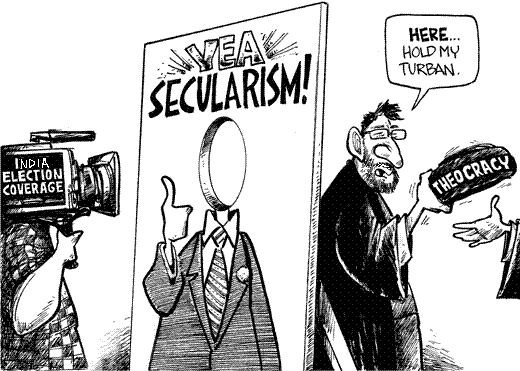
A few decades ago Max Weber expressed the belief that ‘modern society is on a steady and irreversible course toward increasing secularisation’. It was maintained that this process ‘would inevitably lead to the gradual disappearance of religious belief and … religion will have a receding role in that society’(1). This, as Newbigin points out, has turned out to be a myth (2) since the process of secularisation, instead of leading to the gradual disappearance of religious belief, demonstrates 'the continuing and often greatly increased vigor of religious belief in that society'. It is so because a view which excludes the belief systems of other religions is also a worldview, even a religion (3).

Second, Newbigin states that the effort to separate public life from private behaviour and morals is impossible in the long terms, because the way a society behaves is a function of the personal values and beliefs of its individuals. He goes to say that ‘the unprecedented crop of new religions’ in the west also proves this myth (4).

Still, secularism is still prominent in our culture. So, it is important for us to consider in what way culture is being influenced by it and in what way are the questions posed by a secular culture important for mission today.

2. Defining the terms ‘culture’, ‘worldview’ and ‘secular worldview’.

Before we consider the main characteristics of a culture, influenced by a secular worldview, we need to define what the terms ‘culture’, ‘worldview’ and secular worldview’ mean.

There are many definitions of culture but for the present work we shall use the following one: culture is ‘an integrated system of beliefs, of values, of customs, and of institutions which express these beliefs, values and customs, which binds a society together and gives it a sense of identity, dignity, security and continuity’(5). ‘Put simply, it refers to the way that a group of people do things together(6).

Culture is not the same as worldview. Peter Cotterell defines the latter as ‘the individual’s understanding of the world and his relationship to it, his behaviour in it’(7). It is ‘determined by that individual’s religion’ to a great extent(8). So, we may say that secular(9) worldview is an individual’s naturalistic understanding of the world and his relationship to it based on that understanding. The secular worldview’s ‘plausibility structure’(10) excludes the possibility of any religious explanation of the world.

3. Main Characteristics of a culture that is influenced by a secular worldview.

a. Faith in man, progress and science.
Premodern time was defined by faith in God and was best captured in Anselm’s phrase ‘I believe in order that I may understand’(11). What people knew about the world was preconditioned by their belief in the Bible. By the late 1400s, due to the geographical discoveries and scientific and theological developments, the belief in the ‘divinely constituted world’(12) began slowly disintegrating and ushered in the Enlightenment or the beginning of modernity(13). The ultimate authority of knowledge and behaviour shifted from God to reason(14). In order to prove to him and to other sceptics that God really existed Descartes developed the principle of doubt, namely, cogito ergo sum(15). Yet, instead of giving a firmer basis of the Christian faith, this principle led to a major shift in epistemology as finally reason ousted God(16) and turned itself into the only legitimate source and foundation of all knowledge.

This is the first and most important characteristic of a culture influenced by the secular worldview. As a result, God was declared dead and humanity took its place as the centre of the universe. Rousseau’s ‘noble savage’ led to the belief that human beings are naturally good and as such were doomed to progress(17). By reason people could boldly launch into a process of scientific discovery. At the same time, this new anthropocentric worldview led to a shift of interest in science from the metaphysical to man and the physical world. It was characterised by the optimistic belief that science could bring heaven on earth. Humanity did not need God anymore since through reason and scientific progress it could eliminate evil and suffering and bring universal happiness(18).

b. Faith as private not public truth.
Descartes’ principle cogito ergo sum ‘drew a distinction between ‘“the observer” and the “object”, and thus between “mind” and “matter”’. It created a dualism between the material universe and the metaphysical world. The former was to be researched by scientists, and the latter, by philosophers and theologians(19). This

separation of reality into the objective and the subjective has produced a situation in which the objective, or public sphere, has been seen as the important area in which the real world operates. The subjective has come to be seen as the world of opinion which, by implication, is less important(20).


In other words, personal beliefs have ‘gradually become equated (21) with the word “opinion” and the concept of “values”’(22).

c. Individualism.
Since man, and not God, is in the centre of attention in a secular culture, it is the individual and not society which now matters. Society now is merely ‘the product of individual choice’(23) and not something which individuals should respect and try to accommodate to. Whereas in the premodern the emphasis was on the individual’s ‘place and duty within society’(24), in secular cultures the focus is on the individual’s rights(25). Furthermore, the improving standard of living, social benefits and health service in secular states leads to greater independence of individuals from their immediate friends and neighbours, and thus to alienation and individualism.

d. Materialism and hedonism.
If humanity is the only agent of progress in the universe, it follows by implication that its sole driving force for existence would be the ‘pursuit of happiness’. The last decades have witnessed ‘a dramatic upsurge in scientific studies aimed at discovering … what makes happy people happy’(26). The technological progress and the factors mentioned above inescapably led to surplus in production in Western countries. This in turn led to an economic growth and bigger opportunities for individuals to achieve a better standard of living. Mass media and ads brought about the belief that materialism and hedonism are something to be desired and strived for.

e. Nominalism.
As pointed in the introduction above, instead of leading to the disappearance of belief, secularism itself has become a worldview and even a religion in many secular cultures of the West(27). As Robinson points out, put in this context of religious pressure, the Church has tried to come to terms with it, often at the expense of sacrificing its loyalty to Christ. Many churches have ‘accommodated secular thought to such an extent that the dominant problem of the Church in the West has become that of nominalism(28). This has rendered them unable to ‘resist the advance of other faith commitments’, let alone to ‘become a missionary or converting force itself’(29).

f. Religious pluralism and relativism.
Another characteristic of a culture influenced by a secular worldview is religious pluralism and relativism. Religious pluralism is ‘the belief that the differences between the religions are not a matter of truth and falsehood, but of different perceptions of the one truth’(30). Similarly, relativism states that ‘all points of view are equally valid and that all truth is relative to the individual(31). If there is only matter and no god, then all values are relative. This loss of confidence in truth can be directly related to the collapse of the modernity’s metanarrative of optimism and belief in progress after the two world wars and other traumatic events in the twentieth century. So, religious pluralism and relativism are a natural outcome of the ‘disintegration of the traditional western concept of truth’(32) in the pluralist secular cultures. Since there is no ultimate reality as a criteria of truth and falsehood it follows that everything is subjective. In religion this statement translates in the famous phrase ‘all religions are equally valid roads to the truth’(33).

g. Tolerance.
Finally, tolerance is a boundary drawn by the architects of the secular society, ‘in order to insure tolerance for a wide variety of private life-styles(34). Since belief in a culture influenced by a secular worldview is a matter of private opinion, it is easy to see why any ‘claims to truth are to be censured as imperialist and divisive’(35). So, Christians are often accused of being arrogant and intolerant as they claim that Jesus Christ is the only way to God. Ironically, the commitment to religious pluralism of a culture influenced by the secular worldview, leads to it being intolerant to some of the members of its society. As Newbigin points out, ‘in regard to what are called “facts” the secular society is not pluralist’(36).

4. Questions posed by a secular culture and their relevance for mission.

As a result, all these features of a secular culture, namely, individualism, the dualism between the public sphere and the private beliefs, religious pluralism and the collapse of confidence in reason, have brought about much fragmentation, alienation and hopelessness. Many have experienced disillusionment with the gods of a culture influenced by a secular worldview and wonder how they can overcome their loneliness and brokenness, and find happiness. Others, like for example those personally affected by terrorist attacks, ask how a loving God could allow so much suffering in this world. Still others, having found no satisfying answers in atheism or other religions, are wondering whether there is any meaning in this life.

Living in a secular culture has urged many to give up their quest for meaning in the eastern religions or secularism and become more open to traditional monotheistic metanarratives, including Christianity. The in-built awareness and need of the absolute truth, in spite of the relativistic agenda of the secular culture, also opens new possibilities before the mission of the Church. What then would be those approaches in mission that would be relevant for the people in a secular culture? How could the Church best respond to these questions?

a. Doing incarnational evangelism.
As we have seen, a common aspect in a secular worldview is the belief that we exist in order to be happy. It is often stated that the main ingredient to personal happiness are healthy relationships. In a world of individualism and alienation, a caring attitude would make a huge difference for non-Christians. In this we need to turn to Jesus’ example. He associated with all, especially with the outcasts of society. So, before we know how to tell them about God’s love, we need to know how to show it to them. This incarnational witness is counter-cultural as it demands many sacrifices on part of the Church but in the long run it can turn out to be the most effective evangelistic tool(37).

b. Speaking the truth relevantly.
Yet, acts of love on themselves are not enough for an effective mission of the church. We need to also learn to speak out the truth of the gospel in the vernacular language of people. We need to present Jesus as an attractive person rather than as a system of beliefs and make His metanarrative meaningful and convincing. This may involve becoming ‘technologically savvy’ and start using a lot of multimedia, art and music in our evangelistic preaching and missions. It involves also knowing both our text (the Bible) and context (culture and its prevailing worldview).

An important aspect of learning to speak the language of a culture influenced by a secular worldview is to learn to use humor in our preaching, evangelism and friendships. In Robinson’s words, it connects non-Christians with the transcendent, as it ‘speaks of love’, and ‘of the triumph of good over evil’, and ‘brings a sense of wonder rather than despair’ as to the mystery of life(38).

5. Conclusion

Finally, we need to recognise and relate to the features of a culture that is influenced by a secular worldview in our mission. We have seen that these characteristics are either modern, or postmodern, or shared by both modernity and postmodernity, in their nature. Modernistic separation of public facts from private beliefs, confidence in reason, science and progress, and the essential goodness of man have led to individualism and materialism. Further, they have bred religious pluralism, relativism and the myth of tolerance. Ironically, a culture influenced by a secular worldview has erected and worships its own god, the autonomous self.

The result of this worldview is that many have experienced personal fragmentation and alienation both from God and the others in their culture. They ask important questions which the Church needs to hear and respond to: these are questions of meaning, of the relevance of absolute truth to life, why there is suffering and how one can find personal happiness. The implication of these questions is that people in a culture impacted by secular worldview long for wholeness and satisfaction, and these can be offered only when the Church incorporates in her mission not only an oral proclamation but also presence, not only words but also works. In a sea of religious commitments, and in a culture invaded by the secular worldview, this can be the best way for the church to respond meaningfully and adequately to the seekers.

The End
_________________________________________

Endnotes

(1) Lesslie Newbigin, The Gospel in a Pluralist Society, (London: SPCK, 1989), p. 211-2.
(2) ibid.
(3) Irving Kristol also witnessed against this view when he remarked that two major events in recent years represent turning points in the history of the twentieth century: ‘The first is the death of socialism... The second is the collapse of secular humanism . . . as an ideal’. Secular humanism with its optimism in progress and science has also led to immorality since it raised personal autonomy as the criteria for good and evil. When our moral choices depend on our own preferences than it is easy to see how in the long run secularism has led to relativism and postmodernism. Kristol goes on to say that ‘since 2001, the prominent German philosopher Jürgen Habermas has also been announcing “the post-secular age”. Habermas is not about to give up atheism—or even secularism—but his main point can be summarized this way: Secularism has been pushed into a new position in world history; it now appears to be the persuasion of a fairly small minority in a sea of rising religious commitment.’ See Michael Novak, ‘Remembering the Secular Age’, in First Things, 2009, http://www.firstthings.com/article.php3?id_article=5922, [March 12, 2009].
(4)Newbigin, The Gospel in a Pluralist Society, p.220.
(5)This is the abreviated version of the complete definition: There are many definitions of culture but for the present work we shall use the following one: culture is ‘an integrated system of beliefs (about God or reality or ultimate meaning), of values (about what is true, good, beautiful and normative), of customs (how to behave, relate to others, talk, pray, dress, work, play, trade, farm, eat, etc.), and of institutions which express these beliefs, values and customs (government, law courts, temples or churches, family, schools, hospitals, factories, shops, unions, clubs, etc.), which binds a society together and gives it a sense of identity, dignity, security and continuity’. See The Willowbank Report, section 2, in Richard Tiplady, History of Christian Mission, (London: Oak Hill College, 1997).
(6)I.e., it refers to the language, ways of thinking, worldview, beliefs, customs and practices, institutions, religion, festivals, habits and morals of a particular people’. See Richard Tiplady, History of Christian Mission, (London: Oak Hill College, 1997), p. 317.
(7)According to Lesslie Newbigin, worldview is ‘what we think about the world when we are not really thinking’. In other words, it is ‘an in-built set of assumptions that we make about reality which for most practical purposes we just do not question’ - see Martin Robinson, The Faith of the Unbeliever, (London: Monarch Books, 2001), p. 33. Worldviews constitute ‘the most fundamental level of culture’ and ask the question ‘what is real?’ - see Richard Tiplady, History of Christian Mission, (London: Oak Hill College, 1997), p. 321. So, we may conclude that worldview is just one segment of culture.
(8)Peter Cotterell, Mission and Meaningness: The Good News In a World of Suffering and Disorder, (London: SPCK, 1990), p.25.
(9)‘Secular’ is an adjective meaning ‘of or pertaining to worldly things or to things that are not regarded as religious, spiritual, or sacred; temporal’. See Dictionary.com, LLC, 2009, [accessed 15 March 2009].
(10)See Newbigin, The Gospel in a Pluralist Society, p. 25.
(11)Jimmy Long, Generating Hope: A Strategy for Reaching the Postmodern Generation, (Downers Grove, Il: InterVarsity Press, 1997), p. 61.
(12)Albert Borgmann, Crossing the Postmodern Divide, (Chicago, Il: University of Chicago Press, 1992), p. 25.
(13)Long, Generating Hope, p. 61-62.
(14)ibid, p. 63.
(15)‘I believe, therefore I am’.
(16)Thus Descartes introduced, perhaps unwillingly, a dualism between mind and matter, religion and science. See Burnett, D., Clash of Worlds: What Christians Can Do In a World of Cultures In Conflict, (London: Monarch Books, 2002), p. 39.
(17)Robinson, The Faith of the Unbeliever, p.47.
(18)As Burnett observes, all these changes were not appreciated by the majority of the population of the Western society. ‘The success of technology and science seemed to provide proof of the effectiveness of the ideas which were being propounded’ – see David Burnett, Clash of Worlds, (London: Monarch Books, 2002), p. 131.
(19)ibid., pp. 39,40.
(20)Robinson, The Faith of the Unbeliever, pp. VIII, IX.
(21)Newbigin illustrates the impact on our culture of this dualism by pointing to the fact that evolution is taught as ‘fact’ whereas ‘God’s dealings with man through the history of Israel and then of the church’ is taught in terms of values - seeMartin Robinson, The Faith of the Unbeliever, p.45. In Bulgaria media coverages of Eastern-Orthodox festivals refer to the Biblical stories behind those festivals as ‘myths’ or ‘legends’ whereas the claims of all sciences, including ‘social sciences’, are not questioned at all.
(22)Martin Robinson, The Faith of the Unbeliever, p. 45.
(23)ibid, p.47.
(24)ibid.
(25)Interestingly, the attitude to one’s rights and duties within society differ markedly in different age groups in Bulgaria. Young people, who were born and have lived in a culture highly impacted by the European Union agenda of secular humanism, would more willingly stand up for their rights. Older people, who have lived in a totalitarian, though secular, state, would feel more comfortable when asked whether they know their duties rather than their rights.
(26)Science of Happiness: Introduction to the Science of Happiness, in ‘Pursuit-of-happiness.org’, 2008, [accessed 17 March, 2009]
(27)Some of secular culture’s main tenets of belief are, namely, that man is essentially good, that humanity can achieve happiness through faith in reason, science and progress, that faith is a matter of subjective opinion, and that the individual is more important than society – see above.
(28)Robinson, The Faith of the Unbeliever, p.20.
(29)ibid, p.21.
(30)Newbigin, The Gospel in a Pluralist Society, p.14.
(31)Matthew Slick, ‘What is Relativism?’, in Christian Apologetics & Research Ministry, 2008,
[accessed March 19, 2009].
(32)Peter Hicks, ‘Mission, Meaning and Truth’, in Mission and Meaning, ed. By A. Billington, et al. (Carlisle: Paternoster, 1995), pp.306-7.
(33)Чавдар Хаджиев, ‘Разрушаване на крепости’, in Сантасе: приятелско благовестие, (София: БХСС, 2002), p.3.7.
(34)Newbigin, The Gospel in a Pluralist Society, p.218.
(35)Alister MacGrath, Bridge-Building, (Leicester: InterVarsity Press, 1992), p. 148.
(36)Newbigin, The Gospel in a Pluralist Society, p.218.
(37)Consider the example of Christ in John 1.
(38)Robinson, The Faith of the Unbeliever, p.169-70.

_______________________________________________

Bibliography

Borgmann, Albert, Crossing the Postmodern Divide, (Chicago, Il: University of Chicago Press, 1992).
Burnett, David, Clash of Worlds: What Christians Can Do In a World of Cultures In Conflict, (London: Monarch Books, 2002).
Cotterell, Peter, Mission and Meaningness: The good news in a world of suffering and disorder, (London: SPCK, 1990)
Dictionary.com, LLC, 2009, [accessed 15 March 2009]
Hicks, Peter, ‘Mission, Meaning and Truth’, in Mission and Meaning, ed. By A. Billington, et al. (Carlisle: Paternoster, 1995)
Long, Generating Hope: A Strategy for Reaching the Postmodern Generation, (Downers Grove, Il: InterVarsity Press, 1997)
MacGrath, Alister, Bridge-Building, (Leicester: InterVarsity Press, 1992)
Newbigin, Lesslie, The Gospel in a Pluralist Society, (London: SPCK, 1989)
Novak, Michael, ‘Remembering the Secular Age’, in First Things, 2009, [March 12, 2009]
Robinson, Martin, The Faith of the Unbeliever, (Grand Rapids, MI: Monarch Books, 2001)
Science of Happiness: Introduction to the Science of Happiness, in ‘Pursuit-of-happiness.org’, 2008, [accessed 17 March, 2009]
Slick, Matthew, ‘What is Relativism?’, in Christian Apologetics & Research Ministry, 2008, [accessed 19 March, 2009]
Tiplady, Richard, History of Christian Mission, (London: Oak Hill College, 1997)
Хаджиев, Чавдар, ‘Разрушаване на крепости’, in Сантасе: приятелско благовестие, (София: БХСС, 2002)