Показват се публикациите с етикет Bulgaria. Показване на всички публикации

сряда, август 07, 2019

Hatching eggs of faith in the incubator of evil


“Hardly ever people have witnessed a more perfect and effective methodology for liberating man from all moral constraints, from his sense of responsibility, and turning him into a permanent incubator of evil.”
This is a quote from the Bulgarian Solzhenitsyn, the dissident novelist and playwright Georgi Markov. It’s taken from his “In Absentia Reports”, initially radio essays, broadcasted from West Germany by Free Europe Radio, and having opened a window to the truth for the people living under the lid of the totalitarian state. Because of this Markov was assassinated in central London in 1978 by the Bulgarian Secret Services with the help of the KGB-engineered “Umbrella Murder”. Long before the Russian Scripal there was Markov.
Georgi Markov is one of many Bulgarian heroes for liberty. He got murdered because he would not live in fear and lie. The same incubator of evil he wrote about took his life but couldn’t silence him. Today his books can be found at every bookstore in Bulgaria. This year, after a long struggle, finally In Absentia Reports was included in the literature course to be studied by Bulgarian children at school.
Today Bulgaria is no more a communist state. We live in a democracy. The freedom of conscience, the freedom of press, the freedom of religion, the freedom of expression and the freedom of speech are all guaranteed by our Constitution. Yet, in spite of this, now and then Bulgarian politics remind us that the incubator of evil is not gone. We still live side by side with evil.
One of the ramifications of this incubation of evil was the fact that in the end of last year our parliament tried hard to violate at least some of these fundamental rights. Christians in Bulgaria had a sad reminder of a bygone communist past.
It all started with a Parliamentarian bill sponsored by three political parties passed on first reading in October. The bill supposedly aimed at preventing religious terrorism but actually violated the freedom of religion, especially of the smaller denominations.
The problematic articles included a number of disconcerting restrictions, including impeding clergy training; strict filtering of international donations to churches; limitations on sermon content; restraining liturgy to designated buildings; obstructing non-Bulgarians’ ministry; membership of 3,000 for legal registration; allowing special privileges to religious groups over one percent of the population.
This triggered much unrest and many protests throughout the country. At one of the protests in my city I spoke before the people and said: “1132 years ago, the disciples of Cyril and Methodius – Clement, Naum and Angelarius arrived as missionaries to Bulgaria and presented a new religion to our pagan nation, Christianity. If our king had as advisers the people who wrote the religions bill, their mission would have no chances to succeed!”
Thanks to the peaceful protests, hundreds of letters to the MPs, pressure from abroad and the prayers of the saints, most of these restrictive texts were dropped out on second reading. Yet a few of these clauses remained in the new law that was passed. How would this affect the churches?
For now it looks like the evangelical churches won a victory. The relative freedom we have enjoyed the last 30 years will more or less continue. Bulgarian evangelicals can take a breath of fresh air. Yet, the fact that we are taking the win does not mean that we are blind to the fact of the totalitarian tendencies of the government.
According to one of the amendments of the religions law, the Bulgarian Eastern-Orthodox Church and the Muslim religion will be eligible to receive annual state subsidy of almost 10 million US dollars. Moreover, with a later amendment the state tried, for now unsuccessfully, to cancel a debt of the Muslim religion of almost 5 billion US dollars. All these are steps to making the two main religions dependent on the secular government.
The question is, will the Eastern Orthodox denomination and the Muslim religion be able to shake off political influences? Will they be able to give back to Caesar what is Caesar's and to God what is God's? Will they have the courage to stand up for justice and speak up for the truth?
Other amendments are for the denominations to issue certificates to each of their ministers and to register them with the Committee of religions, which gets new and extended powers. Churches are to notify the Committee about every foreign guest speaker.
All this is happening against the backdrop of a new wave of persecution in the Middle East, India, Northern Africa and China, and resurgence of nationalism in Europe. Would we have freedom of religion in Bulgaria in the long run? Would new restrictive measures hinder the spread of the gospel? Is the communist incubator of evil really permanent, as Georgi Markov prophecied 40 years ago? Are we living again in Orwell’s “1984”?
The Bulgarian pastor dissident Haralan Popov remembers in his book “Tortured for his faith”:  “At 4 o’clock in the morning, the doorbell rang, then again and again. There were three strangers there – two were wearing suits and one a military uniform. “We have a search warrant”, said their leader, then he pushed me back and intruded into the sleeping house.
Within three hours they rummaged everything – books, beds, cabinets, drawers. When at about 7 the sunshine shone through the window, they ordered me to go with them for a ‘little inquiry’…”
Today, exactly 70 years after the verdicts were passed on 15 pastors (March, 1949), many evangelical leaders are skeptical about the goodwill of the authorities. As Vlady Raichinov, deputy chair of the Bulgarian Evangelical Alliance says, “Once they were tapered by the clash with perpetuity and lawmaking arrogance, evangelical believers share a sense of anxiety and vague fears that the clouds are yet to thicken.”
What would it mean for us to work for spreading the Gospel in this situation?
Our New Life FWB Church was founded 6 years ago. Besides our Sunday services and Bible study group meetings, we have run more than 100 evangelistic events with  hundreds of non-Christians attending and hearing the Gospel for the first time. What about now? Will we still enjoy the freedom to do evangelism?
Will we be able to invite people and run evangelistic initiatives at our churches? Will we be able to invite non-Bulgarian guest speakers? To conduct Bible studies, English classes, Literature & History Club, movie nights, Bread Houses and cardio checkups for the elderly? Will we be allowed to invite kids to our summer camps and minister at the rehab center and the Macedonian Culture House?
Will it be possible to hatch eggs of faith in this incubator of evil?
Proverbs 4:16 For they cannot rest until they do evil; they are robbed of sleep till they make someone stumble.
A couple of years ago we were conducting our English Music and Sports Project for kids with the help of a CMP team. On the third day of the 7-day project I got a call from a representative of the Religious Affairs Committee at the city council who asked for a meeting with me. When I got there she told me that we can’t conduct our vocal lessons at the Youth Hall anymore although we had applied in advance and gotten permission to do so. So, we had to do all the classes at our two church rooms.
Another time, after I went to advertise a kids project to a group of teachers at a school, one of the teachers said, “We are Eastern Orthodox believers” and almost ruined the whole presentation. Later we were told that she sent a complaint to the Orthodox bishop of Varna and he wrote emails warning all schools not to allow this person (i.e., me), to do sectarian propaganda at their schools.
They really cannot rest until they do evil!
These cases of religious discrimination have been unlawful but in spite of this have been the norm. Now they are already given a legal sanction. Where will all this lead?
If the state continues to exert more control over the church in Bulgaria it is possible that Christians would continue to emigrate to places where they can have their unalienable rights granted.
At the same time, many churches would have to go underground. Orthodox propaganda might increase and state control might grow. Foreign aid might be banned. This might lead to a situation similar to what we had during communism. Another wave of persecution against Christians would not surprise the church in Bulgaria.
The most famous Bulgarian of all times, the leader of the national liberation movement Vassil Levski, said that one day “all people in Bulgaria will live under pure and holy laws as it is given by God for man to live... We want to be free indeed in our land…” Our political leaders hang Levski’s portrait on the wall of their offices but have forgotten his words. One hundred and fifty years later, it seems that Levski’s dream of a free Bulgaria where God’s justice reigns is still not realized.
Yet, if we believe that God is our King, no restrictions in secular laws and no persecution should be able to hinder the gospel. The question is, are we ready to pay the price?
As Christians we should treasure and defend our relative freedom of religion today because God created us with this “unalienable right”. Plato said, "The penalty good men pay for indifference to public affairs is to be ruled by evil men."
Once we paid that penalty and we are still recovering from that evil. We may live now in the incubator of evil but this evil can still be curbed with the truth of the Gospel. So, may God give us wisdom and courage to defend our religious freedom and make sure all Bulgarian citizens have access to the gospel.
Because, restrictions on religious freedom hinder people from hearing the gospel and receiving the greatest gift imaginable, salvation and eternal life.
We run the Christmas Child Operation, an initiative of Samartan’s Purse. We would go to schools and institutions to give shoebox presents to kids and share the gospel with them. After one such event was over, a woman came to Vanya and told her how much she liked what Vanya said in her address to all children and their parents. They exchanged their telephone numbers and met a few days later again. Since then they got along and started meeting and became friends. Some months ago Vanya gave her a Bible and Polly said: “I’ve always wanted to have a Bible, thank you so much!” Vanya invited her to study the Bible together. Since then they have had many meetings. Polly is now a believer and member of New Life Church. Religious freedom is important because people’s eternal destiny depends on us being able to do evangelism!
If the Bulgarian authorities continue to hinder by legal means the witness of the church then I would consider it my duty from God to resist and disobey the restrictive laws. The church should continue to do her mission no matter what the incubator of evil tells her. We are in the world but not of the world.
Pastor Wang Yi, pastor of Early Rain Covenant Church in China, who was arrested together with many believers from his church, says: “I believe the Bible requires me to, in a peaceful manner, in a gentle rebellion and positive patience, full of joy, resist all administrative and judicial measures that persecute the church and interfere with the Christian faith.”
This should be a peaceful, non-violent resistance. We will need God’s wisdom and creativity. We must “be as shrewd as snakes and as innocent as doves.” And we will have to adopt new methods of doing ministry and evangelism. As a last resort, we should go underground and meet at homes. Above all, we should clothe our lives and ministry in Christ’s love and be willing to give our lives for our Lord and Savior. But we should never desert our calling to proclaim the gospel of Jesus Christ.
Psalms 37:9 For those who are evil will be destroyed, but those who hope in the LORD will inherit the land.
Our hope is in the Lord Jesus Christ. Like him, we shall speak the truth and will defend our freedom in Him.
And like the Bulgarian hero Georgi Markov, we cannot live in fear and lie. To him belong the words, “Happiness is in freedom. The freedom to be a person who is equal to all men, the freedom to have the right to your own voice, your own face, your own life.”
And our voice should be of the One in whom we have believed in.
John 8:31,32 “If you hold to my teaching, you are really my disciples. Then you will know the truth, and the truth will set you free.” Yes, God can set us free even while living in the incubator of evil. Free to hatch eggs of faith.
Let me finish by quoting C.S. Lewis who also has something to say on the topic of hatching eggs: “It may be hard for an egg to turn into a bird: it would be a jolly sight harder for it to learn to fly while remaining an egg. We are like eggs at present. And you cannot go on indefinitely being just an ordinary, decent egg. We must be hatched or go bad.”
May the Lord help us to hatch spiritual eggs no matter how pervert and cunning the powers of evil are against us.
Trif Trifonov
_________________
Seminar given at the National Convention of the FWB Churches in Cincinnati, USA on July 24, 2019. 


събота, април 13, 2019

The Book of Proverbs: a Bridge from the Bible into Bulgarian Culture

How to Use the Book of Proverbs as a Bridge from the Bible into Bulgarian Culture
by Trif Trifonov
2003, THE OPEN THEOLOGICAL COLLEGE


Intro

The relations between the Protestant churches in Bulgaria and the surrounding secular culture are far from perfect. On the one hand, Bulgarian society hasn’t still overcome its hostility towards evangelicals, fanned by media and the Eastern Orthodox Church in early 90-ties of the 20th century. We are still regarded by society as national traitors since to most Bulgarians “we are Christians because we are Bulgarians”. On the other hand, the evangelical minority is often too quick to criticise or downplay our own culture as pagan or anti-Christian, refusing to see in it anything positive and good. It is true that many of the traditions and customs, handed down to us, and shaping people’s thinking about God and the created world, are nothing but pagan in their essence. These traditions are so much now part of the Eastern-Orthodox Church services and church life, that they are regarded by the majority as Christian. And yet, it seems to me that future generations (and God!) will hold us accountable for having the same attitude of hostility to His lost sheep in this nation. We need to be reminded that God is not only transcendent, but also immanent (and thus, present in Bulgarian culture, too!) if we want to win people’s hearts and minds for the gospel.

Partly because of the atheistic propaganda of the communists rule, but mostly due to the doctrine of the Orthodox Church, stating that tradition is more important than Scripture (and thus, you cannot read the Bible on your own, but only listen to the priest’s interpretation of its text), modern day Bulgarians don’t know the Bible. To them it is rather an exotic book full of fancy stories, having nothing in common with real life. And, worse still, it is a book that urges people to give up their common sense and become religious fanatics. Nevertheless, in relation to evangelism, the Bible must be our strongest weapon.  The problem is, how to use something that is not only unfamiliar, but also threatening to the average Bulgarian. Are there any common ground, any similarities between Bulgarian culture and some of the books of the Bible that could be used as a bridge from the Bible into that culture? Is there an aspect of Bulgarian culture that is directly or indirectly connected to the Bible?

The answer to this question is “Yes”. Bulgarian folklore tradition has preserved many sayings that not only raise similar topics to those of the Book of Proverbs, but also are similar in content. So, in the present essay I shall argue that the Book of Proverbs can be used as a bridge from the Bible into Bulgarian culture and hence that a comparative study of both should become a prerequisite for working out an effective strategy for evangelism.

Where the common ground lies

Like any other nation’s folklore, Bulgarian language has such a big collection of sayings that we cannot explore all its characteristics and richness. If the Book of Proverbs contains altogether 560 sayings , there are more than 5 000 Bulgarian proverbs or sayings, including some known phrases and words, like blessings, curses, epithets , etc. Yet, in spite of this inequality in number, both collections are rich enough on themselves to be able to touch so many themes and aspects of life representing a complete picture of both societies, that of the early Israel and the Bulgaria of the Middle Ages.

God, wisdom, folly, family, adultery, work, wealth, relationships in the community, and the use of words – these are the central themes in the Book of Proverbs. Bulgarian wise men have something to say on all the above-mentioned, and add to them topics such as freedom, honour, perseverance, hypocricy, stubborness, anger, indifference, patience, greediness, conscience, pride, generosity, obedience and many others. But, for the sake of clarity and space, here I will divide both collections into two major parts: man and his neighbour (horizontal dimension) and second, man and his God (vertical dimension).

At first sight the reader of any Bulgarian selection of proverbs might be tempted to think that there is nothing in common between the godly teachings of Proverbs and the sayings created by a semi-pagan nation, such as Bulgaria. Because, even though Proverbs is “godliness put into working clothes”  it does ultimately bring “the firstfruits of its labour” to God, pointing to Him as our Creator and Judge of all human affairs. On the other hand, how can sayings such as, for example May God keep us from pretending saints and In the daytime - a saint, in the night time a thieve, Closer to church, farther from God, and If you want to know where they serve good wine, ask for the place where priests go to - be taken as teaching morality, or at least a primitive form of piety, in those ancient Bulgarian times? This will be treated more thoroughly further on, but we may now only answer that God’s common grace is accessible even by pagan nations, and he can instill his absolute truths even in the minds of people without revelation. Furthermore, even though most of ancient Bulgarians’ were illiterate, they were more familiar with the central Biblical doctrines than modern Bulgarians and this should have impacted their folklore, too.

But, let us consider in brief some of the above-mentioned topics.

Man and his neighbour

Horizontal relationships form the bulk of Bulgarian folklore. Within that, as it might be expected of a patriarchial society, family is the central theme. It has been the smallest and yet the most important ingredient of Bulgarian society in the past. Bridal fidelity has been the norm, illustrated by the saying Cook for many, make up a bed for two (meaning, bring up many children, have just one husband). Compare with Drink water from your own cistern, running water from your own well. Discipline in rearing up children was also considered indispensible for their future success in life: Children suffer because of lack of discipline. Or, to put it in Proverbs’ terms, He who spares the rod hates his son, but he who loves him is careful to discipline him.

Work for the daily bread occupies most of the time of man. Although Bulgaria has mostly been a poor country, attitude to work as reflected in our folklore is not negative at all. The proverb Work makes man look beautiful, laziness makes him look ugly celebrates work as the highest virtue in people’s character, helping them realise their true potential and finding their true self (comp. with the culmination of the description of the wife of noble character, let her works bring her praise at the city gate ). Much more straightforward is Whoever doesn’t work will not eat, either. And, there is a lot of wisdom in the warning that there are moments in life when we must make the most of our time, and we will be rewarded: A day provides for a year .

Yet, not all members of a society would fit into these discriptions. That’s why among the many affirmative statements in Bulgarian proverbs, there are also many warnings. There are people who succumb to the temptation to work out evil schemes. They should think twice before acting, because Whoever digs a grave for another man will fall into it. Others who prefer the easy looking ways of lying are warned by the means of a metaphor: Lie’s legs are short. In other words, A false witness will not go unpunished, and he who pours out lies will not go free. And there are the grumblers and egoists, who constantly envy their neighbours’ skills or possessions: “The neighbour’s hen hatches bigger eggs”, they say. To this self-irony the Book of Proverbs adds the wisdom of Better a little with righteousness than much gain with injustice. Such negative statements are balanced by other affirmations, referring to such characteristics as honour, dignity, perseverance, peace making, meekness, humility, patience, generosity, etc.

Man and his God

In the array of sayings there are not many proverbs referring to God. Proverbs such as God gives but doesn’t bring (sheep) in the pen, or Closer to church, farther from God are a rarity. By comparison, the Book of Proverbs has 100 verses that mention God in its total of 915 verses. Most of the Bulgarian sayings concerning religion don’t mention directly God (who to the popular mind is too holy and too far to be reached; comp. with the sigh of helplessness when harrassed by the local Turkish princes, The tsar is far away, God is too high…) but target His earthly representatives, the clergy. The proverbs If you want to know where they serve good wine, ask for the place where priests go and The priest preaches the law but doesn’t keep it are typical sayings, critisizing the wickedness and greediness of those who are called to serve humbly the ordinary people. So, if the Book of Proverbs seldom takes us to church, Bulgarian proverbs advise us bluntly to avoid that place. At the same time, if we take for granted the fact that the Book of Proverbs was written in the tenth century and compiled around the 7th century BC, it is clear why pride and apostacy among religious leaders is not attacked anywhere in the book: it hadn’t been a massive problem during the time of the united kingdom. To the Biblical Proverbs it is enough to say: The Lord detests all the proud of heart. Be sure of this: They will not go unpunished.

How to use the Book of Proverbs as a bridge to Bulgarian culture

First of all, in my opinion the Book of Proverbs could be used as a bridge from the Bible into any culture as it speaks about real life. People of all races and languages have strived to find out the key to successful life in the spheres of family relationships, business, their citizenship and its responsibilities, etc. And the Proverbs has much to say on any of these subjects, and many more. Striped of any religious attire, it speaks with a down-to-earth language about everyday life, invisibly instilling in the minds and hearts of its listeners its Biblical perspective. It is convincing enough for them to say: “This sounds interesting; I’d like to try it”. And it can provoke further interest to other books of the Bible.

Second, in the above-given examples we can see that there are many direct borrowings or elaborations on verses from the Book of Proverbs in the Bulgarian sayings. Some of them sound almost identical with the Biblical verses; others put in different words the same or similar message. This can serve as a revelation for many Bulgarian atheists and humanists who believe in social progress and hold the conviction that our culture is a result of the mere efforts of our own national genius. Evangelistic or preevangelistic lectures could be given at universities, tackling all these parallels between Proverbs and Bulgarian sayings and other pieces of literature or even all sorts of art, and proving that the Bible has influenced our thinking and paradoxically governs our collective national behaviour, even though most of us are not aware of that fact. A conference on the topic of “Christian motifs in Bulgarian language and literature” could be held at the eve of the biggest national holiday, the day of Cyrillic alphabet, May 24th. Furthermore, apologetics nights could be organised in universities and other institutions, making use of Bulgarian proverbs as their main agenda.

Something to bear in mind

It is necessary to note here that the fact that Bulgarian proverbs mention only implicitly God and even advise people to have nothing to do with churches could be used by some opponents of Christianity to show that even our predecessors have realised that it is nothing but a “scheme of the rich to control the poor”. To this accusation we may answer that the proverbs’ criticism is directed not towards God but towards those who represent Him before lay people. In other words, the proverbs don’t make the mistake, characteristic of many modern-day Bulgarians, to exclude any possibility for God’s existance on the dubious grounds of his wicked representatives. And, actually, whenever they mention the word “God”, it suggests a personal deity, the holy Agent behind all the created order and things.

Conclusion

After all is said and done, we come to the conclusion that, unlike the Book of Proverbs , man and not God is in the centre of concern of Bulgarian proverbs. Man with his economic and social status, family, business, relationships and character is the subject matter of these proverbs. Yet, the striking thing is that, although religious terms and overt Christian themes are almost lacking in them, the prevailing value system behind these sayings is that of the Bible. Their interest in economic prosperity is subjected to a calling to moral integrity. Their focus on good relationships within the household and the neighborhood is more than a concern for healthy existence; ultimately it is a rehearsal for one’s relationships with God. In other words, physical survival is important, but it is not pursued at the expense of loosing one’s good name, family and ultimately, soul. They silently bow down to virtue, ridicule folly and hypocrisy, and solemnly warn promiscuity and and evil behaviour. And in this they sound almost like their biblical counterparts. That’s why they can make a wonderful inroad for evangelism in this culture. If we give it a try.

The End


BIBLIOGRAPHY

NIV Study Bible, Hodder and Stoughton, 1995
Kidner, D., Proverbs, IVP, 1964.
Kindner, D., The Wisdom of Proverbs, Job & Ecclesiastes, IVP, 1985.
Green, M., Evangelism Through the Local Church, Hodder & Stoughton, 1993.
Григоров, М. & Кацаров, К, Български пословици и поговорки , Наука и изкуство, 1986.
Еленков, Ив и Даскалов, Р., Защо сме такива? , Светлоструй, 1994.
Carson, D.A., France, R.T., Motyer, J.A., Wenham, G.J., New Bible Commentary, IVP, 1994.

понеделник, декември 31, 2018

Freedom of religion and the spread of the gospel


For freedom Christ has set us free; stand firm therefore, and do not submit again to a yoke of slavery. (Galatians 5:1)

“At 4 o’clock in the morning, the doorbell rang, then again and again. There were three strangers there – two were wearing suits and one a military uniform. “We have a search warrant”, said their leader, then he pushed me back and intruded into the sleeping house.
Within three hours they rummaged everything – books, beds, cabinets, drawers. When at about 7 the sunshine shone through the window, they ordered me to go with them for a ‘little inquiry’…”
Thank God, this is not a story of the present. But it is not fiction either. It’s a real story. This took place in the life of a Bulgarian pastor, Haralan Popov, in the first years of the communist regime.
But now the situation is very different, someone would say. Now we live in a democracy, none of these things happen. Freedom of religion is guaranteed by our Constitution: “All citizens shall be equal before the law. There shall be no privileges or restriction of rights on the grounds of race, national or social origin, ethnic self-identity, sex, religion…” (Article 6); “The practicing of any religion shall be unrestricted. (2) Religious institutions shall be separate from the State.” (Article 13)
Yet, in the last three months our parliament tried hard to violate these fundamental rights. Christians in Bulgaria had a sad reminder of a bygone communist past.
It all started with a parliamentarian bill sponsored by three political parties passed on first reading in October. The bill supposedly aimed at preventing religious terrorism but actually violated the freedom of religion, especially of the smaller denominations.
When I am writing this the bill has already been passed on second reading. Thanks to the peaceful protests, hundreds of letters to the MPs, pressure from abroad and the prayers of the saints, most of these restrictive texts were dropped out. Yet a few of these clauses remained in the new law. How would this affect the churches?
For now it looks like the evangelical churches won a victory. The relative freedom we have enjoyed will more or less continue. Bulgarian evangelicals can take a breath of fresh air. Yet, the fact that we are taking the win does not mean that we are blind to the fact of the totalitarian tendencies of the government.
All this is happening against the backdrop of a new wave of persecution in the Middle East, India, Northern Africa and China, and resurgence of nationalism in Europe. Would we have freedom of religion in Bulgaria in the long run? Would new restrictive measures hinder the spread of the gospel?
Opinions are split. Many fear that the Church won’t be able to do the Great Commission. Our wings will be cut off and we won’t be able to fly to the unreached; our legs will be amputated to go to the needy, our hands will be broken to reach the hungry.
Indeed, we have seen this in our history. During communism the Church survived but didn’t thrive. She was deprived of its best leaders, had no access to the public arena, and evangelism was a risky business. I myself learned about the existence of the evangelical churches only after the fall of communism.
On the other hand, there are other voices saying that the Church needs to be shaken up and sifted, so that the chaff is separated from the wheat (Matthew 3:12). The proponents of this view point to communist China where in the last 30 years Christianity has grown to more than 100 million adherents.
Though persecuted, the early church, also grew rapidly in number. Persecution caused many to flee and take the gospel to the ends of the Roman world.
If we believe that God is our King, no restrictions in secular laws should be able to hinder the gospel. Yet, are we ready to pay the price?
Personally, I think that as Christians we should treasure and defend our freedom of religion because God created us with this “unalienable right”. Religious freedom is rooted in the Scriptures and is at the heart of the gospel.
This is seen in the fact that God doesn’t coerce but invites his followers in a relationship with him. God is love, and love presupposes freedom. Christian commitment to religious freedom reflects our beliefs about the character of the Creator.
Secondly, the struggle for religious freedom is part and parcel of the second great commandment to love our neighbor (Matt. 22:38). God has given each human being dignity. When the basic human right of religious freedom is not granted, human dignity is damaged. 
And, last, restrictions on religious freedom hinder people from hearing the gospel and receiving the greatest gift imaginable, salvation and eternal life.
It is true that Christianity in China is growing rapidly in spite of restrictions and pressure from the state. Yet, how can we be sure that it will not grow even faster provided there is freedom of religion in the vast country. The rapid evangelization of South Korea is a case in point.
Back to our situation,ws should be  where it said that  and Chinar places in the world is to е църквата при Себе Си. Гото if the state continues to exert more control over the church in Bulgaria it is possible that some Christians would emigrate to places where they can have their unalienable rights granted. This would bless their receiving countries but will render Bulgarian society rather saltless.
At the same time, many churches would have to go underground. Other churchgoers would just be happy with state interference in church life. Orthodox propaganda would increase and state control would also grow. This might lead to a situation similar to what we had during communism.
Plato said, "The penalty good men pay for indifference to public affairs is to be ruled by evil men." Once we paid that penalty and we are still recovering from that evil. May God give us wisdom and courage to defend our religious freedom and make sure all Bulgarian citizens have access to the gospel.

четвъртък, ноември 05, 2015

Open Your Parachute

I met Dobi during my last visit to the Drug and Alcohol Addicts Center. Dobi is a woman in her 50s, intelligent and still beautiful. Once she was a brave and joyful young woman who enjoyed life and tried extreme sports like parachuting. Yet, with the years she became victim of alcohol and this broke her world to pieces. As I looked in her eyes I realized how much she is ashamed and sorry of her being here.

After we talked a little bit about where she came from and what her job was, I asked her. “Dobi, what do you think about the Supernatural reality. Is there a God?” She said: “Well, I think there is some sort of a power…”

Most of the Bulgarians claim they are Orthodox Christians. Yet, when they have to define what this really means and how God looks like they say that God is just an impersonal power.

Whenever I hear this answer I feel like asking, “That is a very safe thing to say, isn’t it?” On one hand, knowing that the person who asks you is a Christian (and a pastor!) you don’t want to hurt him by saying you don’t believe in the existence of God.

On the other, you decide to simply create a god in your image and likeness. A god that is close enough to help you when you call him and not too close to interfere in your life. Because you realize that God, if he exists, is holy, you can’t bear this.

People want the benefits of being a Christian but avoid the responsibilities a follower of Christ should have. It's like what happened to Bulgaria after the fall of communism. We wanted the benefits of freedom and the free market economy but have ever since been avoiding  the responsibilities of living under the supremacy of law. We try to suppress the trauma of living in an orderly society.

As the Swiss theologian Karl Barth puts it, “religion is a result of the suppressing of the trauma caused by God's holiness.” People avoid their fear and shame in meeting the real God by choosing to create their own ‘safe’ religion and gods.

Yet the Bible tells us that worship of our selves or idols is called idolatry. And idolatry is a sin. The only way we can avoid idolatry and face the trauma of meeting the holy God is through God’s grace. We can find shelter from God’s fearful holiness in Jesus’ wounds.

As we were talking about the difference between dead religion and personal faith in Jesus Dobi was listening. I could tell this was the first time when she, similarly to many others, had to face the real God in her life. She had to deal with the trauma of meeting the holy God. She had to make that jump and open her Parachute. Trust Jesus. I hope she will.

At the heart of our ministries in our New Life churches is exactly this: we ask and persuade the people to turn to the trauma of salvation by trusting Jesus. Please, pray with us for many others like Dobi who have to choose. To live a life of deceitful safety at the expense of eternal damnation. Or, trusting Jesus, to overcome the trauma and live with Him forever.

вторник, април 14, 2015

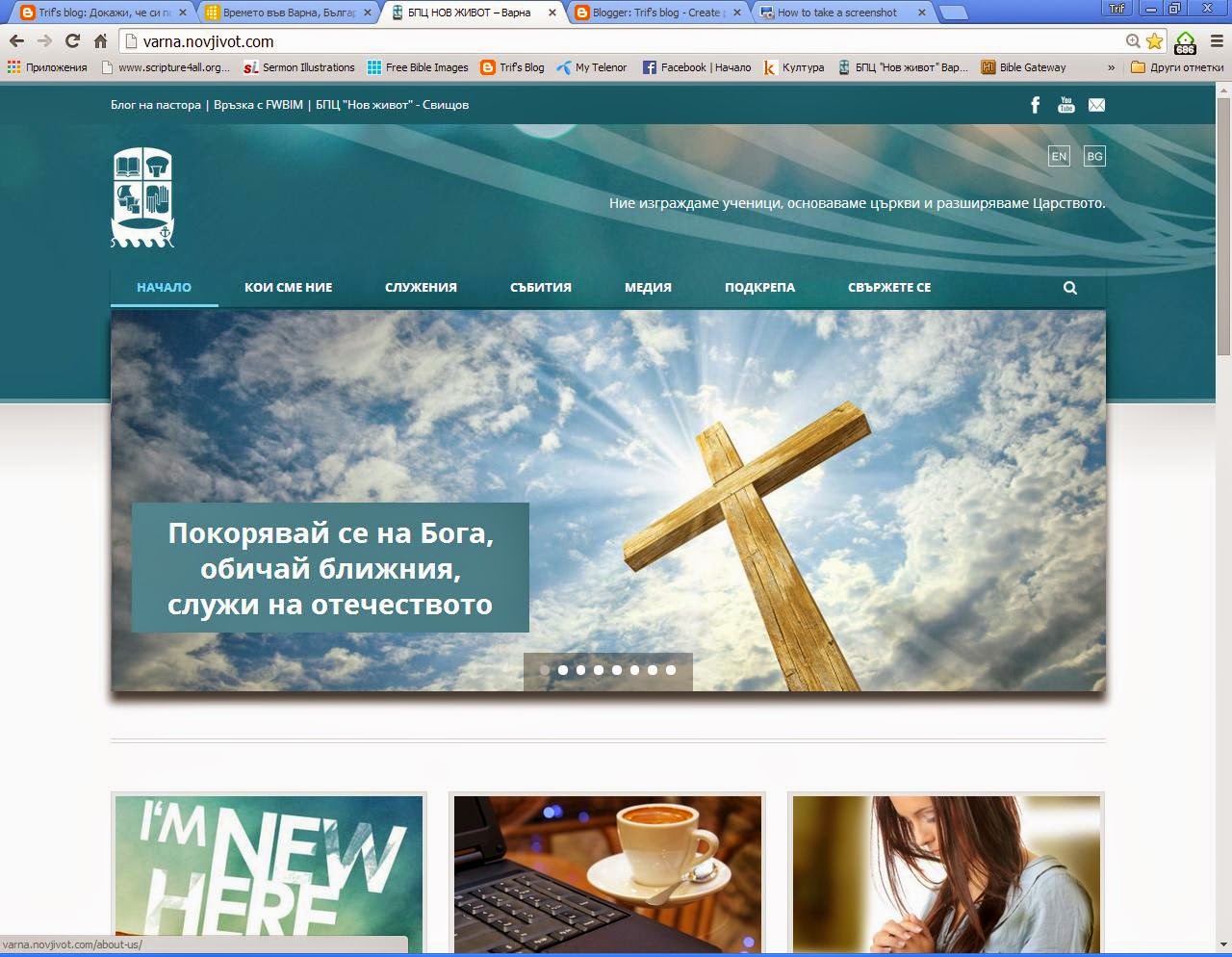
Стартира новият уебсайт на Българска Протестантска Църква "Нов живот" - Варна

Новият уебсайт на БПЦ "Нов живот" - Варна
Миналата седмица официално стартира новият уебсайт на БПЦ "Нов живот". Уебсайтът впечатлява с опростен, но естетически въздействащ дизайн. В центъра се отваря голям слайдър, на който уебсайтът ви посреща с най-актуалната информация за провеждащи се или предстоящи инициативи. 

Над слайдера можете да се запознаете с изложението на целта на нашата църква: "Ние изграждаме ученици, основаваме църкви и разширяваме Царството." Най-отгоре вляво има връзки с блога на пастора, уебсайта на Free Will Baptist International Mission и уебсайта на БПЦ "Нов живот" - Свищов.

Над слайдера е и основното меню. Там можете да намерите информация за мисията, целта и историята на църквата. Просто идете на менюто "Кои сме ние" и там ще откриете всичко, което ви интересува за църквата. Ще се запознаете с пастора и служителите, и с всички служения които църквата развива в момента. Цялата тази информация е налична и на английски в английската версия на сайта. 


В раздела "Медия" посетителите ще могат да слушат всички проповеди и лекции, проведени в църквата. Предимство е публикуването на текста на проповедите в отделна връзка към блога на пастора. Проповедите ще се актуализират всяка седмица. Освен тях на сайта се качва и информация за предстоящи събития. 


В "Свържете се" можете да намерите контактна информация на пастора и да се ориентирате за местоположението на църквата. 

Ако за пръв път посещавате църковен сайт и не сте били в протестантска църква, връзката "Аз съм нов тук" ще ви запознае с това как протича едно богослужение в БПЦ "Нов живот". 

Помислено е и за хората, които търсят Бога и желаят да научат повече за това как могат да станат християни ("Как да стана християнин"), както и за тези, които желаят да подкрепят с молитва и дарения църквата ("Подкрепа").

Надяваме се, че уебсайтът ще бъде полезен за всеки, който иска да научи повече за това в какво вярват християните и сам да намери отговор на вечните въпроси на живота.  


понеделник, януари 12, 2015

Пътеводител на християнския стопаджия

/проповед/

Обичате ли да получавате поздравителни картички? Едно семейство получило поздравителна картичка за раждането на тяхното бебе. На нея пишело: „Как може двама толкова красиви хора да имат толкова грозно бебе?”

Днес все по-малко хора изпращат картички по пощата. Днес хората се обаждат по телефона и пишат пожелания във фейсбук за рождените дни и празниците на своите близки и приятели. Обикновено пожеланието е „много живот, здраве и щастие!” Повечето пожелания не се отличават с oсобена оригиналност.

Петър също започва писмото си с поздрав. Но за него поздравите са нещо повече от формалност. Първите християни са се поздравявали с „Хаирейн” – Желая ти радост! Петър обаче приветства с пожелание за благодат. Той пише: „Благодат и мир да ви се умножи!” Благодатта е Божията любов в действие. С други думи, той казва: „Божията любов да подейства в живота ти!” Това е много повече от пожелание.

„Благодат и мир да ви се умножи!”

В апостолското приветствие благодатта е свързана с мира. В СЗ свещениците са изричали Божието благословение за мир, с което се благославяме и ние в края на служба: „Господ да издигне лицето Си над тебе и да ти даде мир!” (Числ. 6:26). Израел е загубил това благословение поради греховете си, но неговите пророци виждат деня, когато Бог ще изпрати Княза на мира и ще освободи Своя народ не само от потисниците, но и от греховете му (Мих. 7:14-20).

Симон Петър познава Княза на мира. Той идва не за да донесе политически мир, а мир даден в сянката на кръста. Затова неговият поздрав „Благодат и мир да ви с умножи” е обобщение на цялото послание. Петър пише на онези, които чувстват презрението и злобата на невярващия свят. Апостолът пише от Рим около 63 г.сл.Хр., когато на власт е Нерон, само година преди големия пожар в Рим.

Някога Петър беше извадил нож, за да не допусне да арестуват Исус. Сега Петър благославя с мир, който идва не чрез меч, а чрез кръста. Скоро ще настъпят бурни времена на гонения. Целта на Петър е да задълбочи познанието на цялата Църква в Мала Азия, за да могат вярващите да посрещнат изпитанията със силна надежда в Христос.

Петър започва, като казва, че е апостол на Исус Христос (1:1). Той е упълномощен от него да проповядва в Негово име. Затова когато четем неговото послание, ние ставаме приемници на апостолските истини. Така стъпваме на темелите, положени от апостолите. Живото апостолско слово, а не старовременните одежди, архаичния език и древните ритуали определя коя е истинската Църква Христова. Затова когато четем псланието ние четем не толкова посланието на Петър до християните в Мала Азия; ние четем посланието на Духа на Христос до Църквата на всички времена!

По-нататък, Петър нарича неюдеите в тези църкви „избрани по предузнанието на Бога Отца” (1:2). В Деяния четем как Бог е променил ума на този обрязан юдеин и от човек, който не понася езичниците той ги привества като избран от Бога и свят народ!

Петър е видял как богобоязливият езичник Корнилий и семейството му са получили същия Свят Дух, който слиза над вярващите юдеи на Петдесятница. Бог ги е предузнал и тяхното присъединяване към Божия народ не е приумица, а цел на Бога отпреди създанието на света. И сега те са обект на Неговата безвъзмездна благодат и предопределена любов. Бог е техният Отец. Затова те трябва да оставят своя грях и да станат святи, защото Бог е свят. (1:16).

„...избрани по предузнанието на Бога Отца, чрез освещението на Духа, за да сте послушни и да бъдете поръсени с кръвта на Исус Христос.” (1:2)

Петър говори за Святия Дух и за Исус Христос, като описва как Бог е осъществил своя велик замисъл. Бог избира Своя народ „чрез освещението на Духа, за да сте послушни и да бъдете поръсени с кръвта на Исус Христос” (1:2). Триединният Бог – Отец, Син и Свят Дух, осъществява нашето спасение.

Святият Дух ни освещава първоначално, пренасочвайки ни от живот в греха към живот в святост. Нашето послушание води към спасителна вяра. Христовата кръв пък, поръсена върху нас означава, че Бог ни е приел, защото наказанието за греха е понесено. Някога Петър увещава Исус да не отива на смърт на кръста: „Бог да ти се смили, Господи; това никак няма да стане с Тебе” (Мат. 16:22б). Но сега той разбира необходимостта от смъртта на Христос и смисъла на Неговото възкресение. Исус „сам понесе в тялото Си нашите грехове на дървото, така че като сме умрели за греховете, да живеем за правдата” (2:24).

„Пръснати” и „пришълци”

И най-накрая, тези неюдеи, които се наричат Божи народ, избран от Отца, осветен в Духа и поръсен с кръвта на Исус, са още ‘пръснати’ и ‘пришълци’, т.е., чужденци, временно пребиваващи, странници, отправили се към своята родна земя. Какво иска да каже с тези две думи Петър? Какви са тези странници, пришълци?

В „Пътешественикът” на Джон Бънян виждаме класически пример за земното ни странстване в следване на Христос. Християн е толкова силно привлечен от Небесния град, че не обръща много внимание на света, през който преминава. Не се спира, за да построи молитвен дом в Града на суетата, не намира и средства да пресуши Тинята на отчаянието.

Авраам беше пришълец в Обещаната му от Бога земя. Той дори нямаше собственост в нея с изключение на пещерата Макпелах, където погреба Сара. Но гледаше към Божиите обещания и към Небесния град.

В духовен смисъл ние също сме странници и пришълци в този свят. Но как да живеем тогава? Дали да бягаме от света или да се борим срещу него? Да се приспособяваме ли като някои духовни хамелеони или да се опитваме да го променим? Какво означава да сме пришълци в една страна, където властва злото в най-различните му измерения, в която княз е Сатана? Как можем да сме патриоти в една страна, която не можем да припознаем като своя родина?

Думата, използвана на гр. език за „пръснати” е „диаспорас”. От там идва и думата диаспора - хора от даден народ, разпръснати в чужди страни. Ние, българите, знаем какво означава разпръснат народ. След освобождението от турско робство и войните, много българи остават в други страни. Днес много българи сами решават да емигрират. В миналото сме били уседнал народ (макар и да ни вменяваха номадството), но ето че все повече от нас днес стават емигранти. Превръщаме се в народ от номади.

Тези съвременни номади са наречени от френския християнски философ Жан Брун „скитниците на Запада”. Човек, казва той, е странник, който се стреми да избяга от самия себе си. Той оприличава съвременния човек на полубога, получовек Тантал от гръцката митология, който е осъден да страда от вечна жажда под клони, отрупани със зрели плодове, които така и не може да достигне.

По същия начин човекът от западната цивилизация, към която и ние се числим, напразно иска да преодолее ограниченията на пространството и времето, като изобретява все нови и нови технологии, мечтаейки да достигне колкото е възможно по-далече и по-високо. Лелее да построи своята Вавилонска кула. Човекът иска да има власт над природата, да бъде сам бог на своя живот.

Човекът на изтока също търси пътя към небето, но при него той е насочен не навън, а навътре. За разлика от западняка, Буда не протяга ръце към непознатото или новите технологии, а ги държи скръстени (Брун).

Буда живял като принц в двореца. Там не му липсвало нищо. Но като станал на 29 г. решил да излезе за пръв път навън и да се запознае с в живота на обикновените хора. Там видял стар човек, болен човек и разлагащ се труп. Така се сблъскал с дукха, страданието.

Започнал да се пита как може да избегне дукха. Изход от страданието намерил в осмократния път (правилно разбиране, правилна мисъл, правилна реч, правилно поведение, правилни средства, правилно отношение, правилно мислене, правилна концентрация (медитация). Колко различно от учението на Христос, който казва, че не можем да се спасим със собствени усилия!

За човека на изтока изходът от съвременната ‘дукха’ (стрес, мъка, страдание) е в потискането на желанията. Както се изразява Жан Брун, „източният мистик не грабва инструменти, за да построи кула до небето, а използва ръцете си в стилизирани жестове на медитацията и танца. Той нарича живота на земята илюзия, но така става жертва на истинска илюзия и не може да се освободи от непрестанното чувство за несретност и мъка.”

Както западният практик, така и източният мистик се стремят към собствена слава. Както казва св. Августин, „земният град се слави със себе си, небесният Град се слави с Господа”.

В историята на човечеството виждаме този стремеж към бягство от реалността и дирене на духовно съвършенство и вътрешен мир, в непрестанните човешки търсения. Велики империи като Асирия, Вавилон, Персия и Рим, Армения, България, а днес и Русия, са търсили постигане на трансцедентното в политическото господство.

Велики пълководци като Александър Велики са се стремили да завоюват нови и непознати земи. Виждаме го у поклонниците и кръстоносните походи в средновековието. Колумб също е вярвал, че изпълнява мисия на разпространение на християнството, когато открива новия свят.

След това виждаме първите заселници в Америка, които бягат от религиозно преследване в Англия с намерението да установят един нов свят, където да бъде „Божията воля, както на небето”. Виждаме този трансцедентен копнеж дори в богохулника Ницше, който копнее за свръхчовека. Този копнеж по-късно ще се изроди в уродливата теория и практика на националсоциализма и комунизма, чийто призрак още броди по разбитите плочки на чалгизирания ни град.

Днес това преследване на трансцедентното е видно и в стремежа на човечеството да покори космоса и установи извънземни форми на живот. Мантрата, повтаряна от мнозина в нашия технологичен век е „Трябва да има някой там някъде!” Много хора мечтаят генното инженерство да създаде нов вид хора, които да владеят „Силата”. Новата митология и опиум на народите, родени с Междузвездни войни, е научната фантастика.

Всички тези усилия за намиране на трансцедентност в невярващия свят обаче са напразни и безплодни. Затова в увода към своето послание, Петър ни напомня, че ние сме пришълци в света. Ние не принадлежим на този свят. Той не е нашият дом. Ние се новородихме, за да живеем другаде. И ако не помним това, можем да се депресираме. Защото Исус ни каза: „В света имате скръб.” (Йоан 16:33).

Тази скръб кара хората да търсят пътя към рая, но не го намират, защото не търсят Пътя. Хората са депресирани и в отчаянието си чукат на всяка врата, изпречила им се на пътя, но не посягат към Вратата Исус. Шест милиарда духовни стопаджии са объркали пътя и се нуждаят от верен компас! Нуждаят се от пътеводител.

Кой друг ако не Църквата Христова ще ги насочи към Христос? Затова Петър е загрижен за свидетелството на християнската Църква пред езичниците, сред които живеят вярващите (2:11-12, 3:15-16). За Петър християните са пришълци и чужденци, но и посланици. Те отхвърлят безкритичното приспособяване към света, но приемат отговорността да живеят като уважават закона, почитат управниците и своите сънародници.

Въпросът, който Петър ни задава днес е: какво прави църква „Нов живот” Варна, за да стане пътеводител за тези изгубени странници? Какво правиш ти, за да насочиш духовните стопаджии от твоето семейство, твоя блок, твоята работа? Божий посланик ли си за тях? Молиш ли се за тях? Свидетелстваш ли им за вратата Исус? Насочваш ли ги към небесния Ерусалим? Каниш ли ги на църква, за да се запознаят с други граждани на Божия град?

Хората на запада живеят с илюзията, че могат да намерят щастие в земния Вавилон. Хората на изтока живеят с илюзията, че могат да намерят покой чрез бягство от удоволствията вътре в себе си чрез медитиране. Ние сме избрани по предузнанието на Отца, осветени от Духа и измити от кръвта на Исус Христос. Затова единственият начин да стигнем до небесния Ерусалим е не чрез собствени усилия, а чрез поклонение пред Бога. Защото сме странници в този свят. Нашият дом е на небето.


Молитва. 

БПЦ "Нов живот" - Варна
11.01.2015 г.

четвъртък, февруари 13, 2014

Накъде сочи олимпиадата в Сочи


Вече няколко дни ‘светът е олимпиада’. Не знам дали светът чак толкова се вълнува около зимната олимпиада в Сочи. Може и така да е, след като почти половината кенийци щели да я гледат. На хората им трябват хляб и зрелища.

По време на олимпиадата в Москва през 1980 бях на 11 г. Тогава не само гледах почти всички състезания, но и се чувствах горд от успехите на родния спорт. По онова време все още не знаех, че повечето велики спортни сили са обявили бойкот и не участват в игрите заради военната намеса на Русия в Афганистан. Не знаех нищо и за престъпленията на съветския комунизъм и за трагичната му роля в най-новата ни история.

Днес обаче не е 1980-та, а е 2014-та и вече не съм на 11, а на 46 години. Въпреки продължаващата пропаганда на петата колона по света и у нас, не би трябвало да имам илюзии какво точно се случва на североизток от нас. Империята на злото се разпадна, но злото остана, останаха и неговите имперски амбиции. Русия е все още далеч от демократична страна.

В тази страна властта все още преследва, репресира и убива журналисти (повече от 300 за последните 10 години!). Корупцията в Русия надминава въображението дори на навикналите на огромно източване на обществени средства мои съграждани. Говори се, че от платените 51 милиарда долара за игрите в Сочи по предназначение са използвани едва 10%. Строителните дейности са извършвани при минимално заплащане (заедно с изнудване и неплащане на последните заплати) от работници от бившите съветски републики, в това число и бесарабски българи. Необмисленото строителство е довело до насилствено изселване на много хора и тежки екологични последици за населението в района.

Но погледът на Москва не е обърнат само навътре. За да си върне загубеното величие на световна сила, Русия се стреми всячески да прикотка предишните си сателите в създадения от нея евразийски съюз. Огромни обществени средства се заделят, за да се спечелят Украйна, Армения, Беларус, Грузия, Молдова, Унгария (!) и разбира се, България. Русия удря щедри финансови инжекции в тези и много други страни – дотолкова, че вчера ЕС реши да наеме лобисти, които да противодействат на провежданата от Русия ‘дезинформация.’

Да не говорим за ролята на Русия за удължаването на кървавата агония в Сирия и продажбата на оръжия на режима на Асад. Други страни, които купуват руско оръжие са Китай, Индия, Венецуела, Алжир, Малайзия, Виетнам... все страни известни със своите ‘демократични’ завоевания.

Та, когато чуя ‘олимпийски игри’, погледът ми сочи не към Сочи. Замислям се за България, Сирия, Молдова и Армения, за Китай и Виетнам, за спираща дъха корупция, за бедните гастарбайтери и богатите руски олигарси, за Анна Политковская и стотиците журналисти-жертви, за руските монополи... И да ви призная, някакси не ми е до спорт.  

Не знам какво мислите вие. Но както се казва, от ‘хигиенни съображения’ аз реших да бойкотирам тези игри. Не ги гледам. Тoва е моят начин да протестирам срещу използването им за рекламиране на един по същество зъл режим.

След 4 години идва световното по футбол – пак в Русия. Дали тогава Русия ще е различна? 

вторник, януари 28, 2014

Tribute to King Boris III

TIME Magazine, Monday, Jan. 20, 1941

World War: Lowlands of 1941

Separated from The Netherlands by the breadth of Europe, by an even broader gulf of culture and blood. Bulgaria was last week forced to face a grim and startling fact: in the strategy of World War II, Bulgaria is The Netherlands of 1941.

Now, as a year ago, the Nazis hope to win the war by knocking Britain out. But Britain is difficult to reach. A year ago, leaving that difficult project in abeyance, the Nazis chose the main Allied Armies as their major objective. Those Armies were in France and the easiest military way to reach them was through The Netherlands and Belgium.

This year, the main Allied Armies are in the eastern Mediterranean: the Greeks in Albania, the British and Anzacs in Libya. And the easiest way for the Nazis to get into the area where the Allied arms are now rampant—the only way to get there by land—is through Bulgaria and its neighbor Yugoslavia. So 1941 finds Bulgaria and Yugoslavia in much the same predicament as Belgium and The Netherlands in the first weeks of 1940.

Twice—in November 1939, and in January a year ago—the war of nerves in the Lowlands focused into specific scares. Imminent attack was rumored. Concentrations were observed across the border, deadlines were whispered about. Last week Bulgaria was in the same spot strategically and nervously.

More Than Ulcers. At 6:05 one evening last week, Bulgaria's Premier Professor Bogdan Filoff arrived back in Sofia after five days in Vienna. To newspapermen he said curtly: "Reports circulated in America concerning my visit to Germany are not true." He had really been to see his doctor, nothing more.

But though it was late in the day, he went straight to his office. Next day he drove 43 miles to the piney winter resort of Tcham Koria and told King Boris all about his trip to see his doctor. Next day he and the King talked again. That night he called the Cabinet together in Sofia for an unusual night session, and told them about his health trip.

Something more crucial than Bogdan Filoff's stomach ulcers was discussed in those feverish sessions. That something could only have been one thing: whether or not to grant Germany troop transit through Bulgaria or at least use of air bases in Bulgaria, so that the big end of the Rome-Berlin Axis could get the little end out of its Grecian swivet. The Bulgars' decision might make no immediate difference whatsoever: the Germans could undoubtedly penetrate Bulgaria whether the Bulgars wished it or not. But the ramifications of the decision might have heavy bearing on the outcome of the whole war. On the weary spine of Boris III, who never wanted to be king in the first place, rested a backbreaking, heartbreaking weight.

Pan-European. Boris of the Bulgars is an amiable man. He is a peace lover who likes to mount butterflies' wings and study delicate mountain petals, to step on automotive accelerators and pull locomotive throttles—to work at nature and play at science. At 18 he graduated from the Sofia Military Academy, and he fought in both Balkan Wars and in World War I. But he prefers his pastimes of peacetime: traveling about his countryside incognito, walking around the streets of Sofia in sloppy civilian clothes, tinkering with machines, exercising his proud borzois, chatting with peasants. He gives the impression of wishing he weren't King. He has said: "It would not frighten me if I were to lose my throne. If that were to happen, I would go right to America and get a job as a mechanic." Now
that the strategy of war has put Bulgaria on the spot, Boris, man of peace, is the focus of manifold pressures. He rules over a nation of Slavs. His blood is mostly French. His relatives belong to the royal families of Britain, Belgium, Portugal, Rumania. His wife is a daughter of the King of Italy. He is of the Greek Orthodox faith. Tsar Nicholas II of Russia was his godfather. For 22 years his father, ex-King Ferdinand, has been a refugee in Germany.

Besides these personal ties of Boris, Bulgaria has long been the closest European friend of Russia, has long been the route of Germany's hoped-for expansion into the Near East. Recently someone is said to have asked the King what Bulgaria's foreign policy was. Boris answered: "My ministers are pro-German, my wife is pro-Italian, my people are pro-Russian — I am the only neutral in the country." Boris was not just making a phrase.

His people have bonds of speech, culture, tradition, blood and sentiment with Russia, and they will never forget that it was Russia which delivered them from the Turkish yoke, and created the short-lived Big Bulgaria of 1878. But Boris' ministers — especially Premier Bogdan Filoff and the man who controls Bulgaria's police, Minister of Interior Peter Gabrovsky —think that realism demands that Bulgaria play the Nazi game, even if it means a humiliation like Rumania's. Naturally, Queen loanna thinks Bulgaria should put one foot in the Italian boot even if it means the other foot goes into the grave Only Boris has the very simple aim: Bulgaria for the Bulgars—if possible. But Boris may have to face the fact that in 1941 it is not possible. Shortly after he visited Berlin in November, Hermann Göring very pointedly remarked to a Bulgarian correspondent: "Your king is entirely too neutral to suit us. Anyway, there is no place for kings in the new European order."

The Threat. Last week it appeared that Germany's patience with Italy's bungles had just about sapped away. The Berlin correspondent of the Belgrade Politka wrote: "The impression is that Berlin no longer considers the Italo-Greek conflict as a mere local incident, but one that is daily becoming more disagreeable.Click to Print German circles warn Greece to think well and take a lesson from the fate of Finland."

Germany may prefer not to have a major front in the Balkans—one which might repeat the patterns of 1918. British and Greek successes in the Mediterranean area threaten to swell the Greek conflict into such a front. The threat, it is true, was last week not immediate, since General Sir Archibald Wavell's continued advance into Libya (see p. 25) seemed to indicate Britain was committed to destroying Italy's Libyan Army, to the exclusion of new business for some time to come. Neither was the threat too serious: the Salonika campaign by which the Allies conquered the Balkans in 1917-18 required no less than 28 divisions—far more troops than Britain and Greece could marshal just now.

Nevertheless the threat existed. If the British ever established an expeditionary force securely in Salonika, the threat would become imminent. Last week Hitler began to try to eliminate the threat in its infancy (see p. 25}.

But a cardinal point in modern German military theory is that allies should fight separately. The Nazis say that instructors, technicians, advisers of a superior ally (which always happens to be Germany) may assist an inferior, but major campaigns should never be undertaken jointly.

Therefore, if another route were open by which Germany might strike Greece alone, it would be logical to expect the Nazis to take it. That route exists, a much shorter, more convenient route than through the Brenner and via Italy. It lies across Yugoslavia and Bulgaria to Salonika.

There were plenty of indications last week that the German Army was preparing to take this short way. Some 30 divisions were gathered in Hungary and Rumania, and more were on their way. Last week 700 huge pontoons, capable of supporting large tanks and trucks, were reported being moved up to the
Danube. Rumanians were ordered to have gasoline depots well dispersed and fully equipped by the first of February.

Balkan rumors set a deadline for the German attack. Some rumors even had German troops already in Bulgaria, in mufti.

But the deadline passed. A deep blanket of snow made communications by rail and wire uncertain and made a war by mechanized forces almost impossible. As Italy found in Greece, it does not pay to fight Balkan troops under conditions which give an advantage to old-fashioned armies on foot. Moreover, the Danube was frozen—not heavily enough to bear mechanized forces, too heavily to tolerate pontoon bridges. And there are only three permanent bridges over the Danube. Unless the British appeared in Greece in force, there was no need for haste. But the main reason why such a push could well be postponed until springtime was that political bridges had not yet been finished.

Friend or Foe? The biggest unfinished span was, as always, the Soviet connection. Obviously, Russia would not particularly care to have her little friend in the Balkans pass like Rumania into German hands. One day last week an unknown young Russian diplomat, Alexander Mihailovich Alexandrov, said to have been chief of the Balkan Division of the Foreign Commissariat, turned up in Sofia as Counselor of Legation, reportedly charged with giving Boris moral support in refusing German demands. Another day Tass, the official news agency, issued a gruff statement: "If German troops really are present in Bulgaria and if the further dispatch of German troops to Bulgaria really is taking place, then all this occurred and is occurring without the knowledge and consent of the U. S. S. R."

Germany obviously could not afford to antagonize Russia and thus confirm rather than confine the war's second front. Such an alienation would almost certainly bring Turkey into the fight. But it was equally clear that Russia did not dare fight Germany. It was reported: 1) that Adolf Hitler. had offered Joseph
Stalin all of Finland and more of Rumania in exchange for a free hand against Greece and Turkey; 2) that he had offered Boris more of the Dobruja in return for permitting German troops the use of Bulgaria as a corridor to the eastern Mediterranean.

But with a little more time Adolf Hitler would surely find means to bluff or persuade Stalin and either satisfy or scare Boris III. Boris ought to scare, for his chance of getting adequate aid from either Greece, Turkey or Britain for defense of his country is not bright.

Until Hitler could make his preparations for taking Bulgaria without a fight, his advance army of psychological sappers continued busily undermining, camouflaging, sending up trial rumors and tentative untruths, paving the way for a Blitzkrieg in the spring just as they did in the Lowlands in 1940. Such a welter of conflicting reports was abroad in the Balkans last week that the Nazis were actually surprised. "It's a splendid fog," said a happy Berlin spokesman, "and others made it for us."

"Only for Bulgaria." At week's end, the worried conferences which Bogdan Filoff had had with his King and his Cabinet bore fruit. He went to Russe, on the Danube, just opposite the spot where the Germans were supposed to be most heavily concentrated. There he made a speech in which he voiced the sentiments of Boris:

"People should bear in mind that we are today witnessing one of the greatest cataclysms that history has ever known. . . .

"We should not be influenced by our feelings or sympathies or desires. We must remain, before everything else, Bulgarians, and work only for Bulgaria, to be ready to make sacrifices only for Bulgarian interests and never for foreign ones. . . .

"I must warn you that today war and peace do not depend on small nations like Bulgaria. She is so small that she cannot dictate whether there shall be war or peace. We have therefore to be ready for any eventuality. . . ."

Article taken from here.